Get Full Government Meeting Transcripts, Videos, & Alerts Forever!
Get email alerts on the Housing Vouchers topic
No spam. Unsubscribe anytime.
San Diego Housing Commission proposes voucher changes to avoid cutting assistance for more than 1,700 families
Summary
SDHC told the council it will submit proposed calculation changes to HUD in early 2026 to close a funding shortfall in the housing choice voucher program; the agency said the changes aim to prevent ending assistance for roughly 1,700 families and included a plan for multilingual outreach and resource fairs.
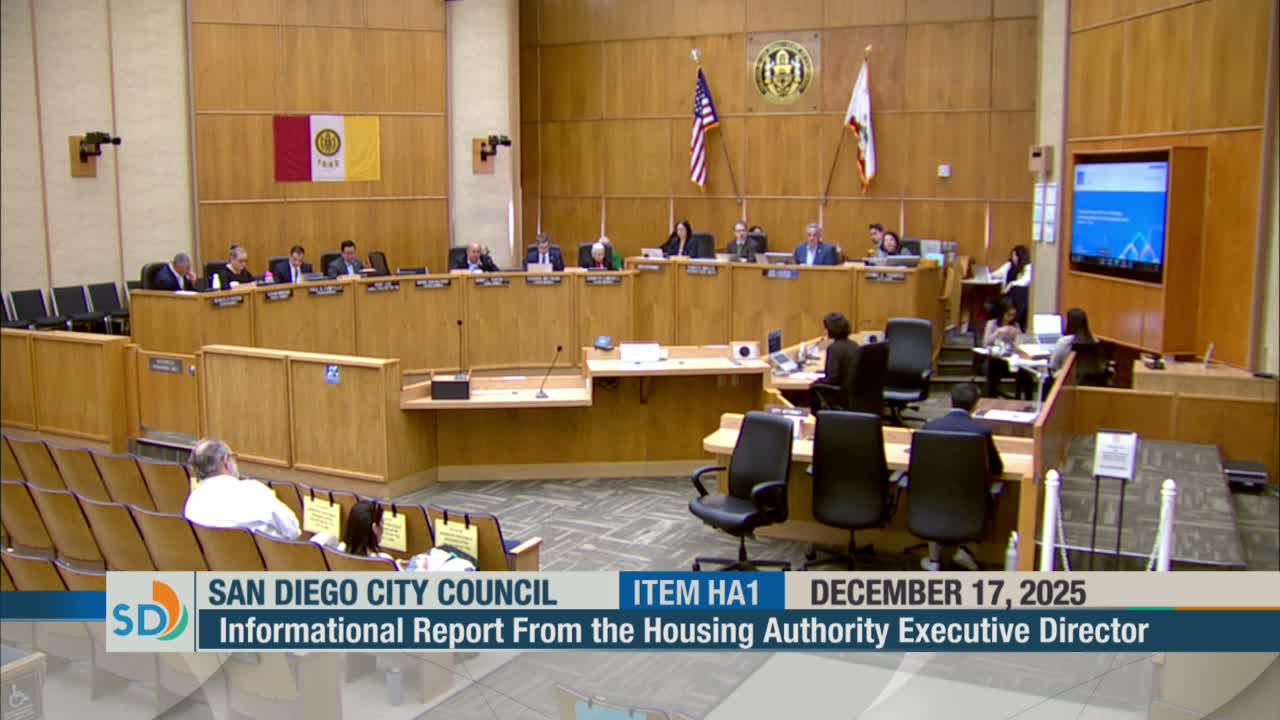
The San Diego Housing Commission on Dec. 17 briefed the City Council and the Housing Authority on proposed changes to the housing choice voucher program that SDHC says are necessary to close a federal funding gap and avoid ending assistance for more than 1,700 families.
Lisa Jones, SDHC’s interim executive director, told the meeting that the agency serves thousands of households in the voucher program and is facing a shortfall in federal funding that has grown as program costs rose. "By increasing contributions across the program, we're aiming to address the deficit in the voucher program and avoid having to end assistance for over 1,700 families," Jones said, and added the changes would be submitted to the U.S. Department of Housing and Urban Development for review in February or March 2026.
SDHC said the proposed adjustments would change how it calculates each household’s share of monthly contract rent; the agency emphasized that any change is contingent on HUD approval. If HUD signs off, SDHC said it would provide months of advance notice and follow a robust outreach plan that includes mailed notices, a community resource web page in nine languages, resource fairs, targeted briefings and partnerships with community-based organizations to help impacted households prepare.
Public commenters at the meeting included residents with lived experience who described fear and stress about potential rent-share increases. One speaker, who said she receives a Social Security cost-of-living increase of about $30 a month, noted that even a small change to a household’s percentage-share of rent could erase that modest gain: "I scrape by...Now I'm being informed that my share of rent will go up...Instead of 30% of my income, I'm going to be paying 32% of my income," said Julie Porter, a member of the Lived Experience Advisors.
Jones outlined SDHC’s outreach to date: an earlier public-notice period, presentations to the board, a workshop and a public hearing; a mailed letter to a random sample of 2,500 voucher households; and nearly 40 briefings with partner organizations. SDHC said it has created a multilingual resource page (English, Spanish, Vietnamese, Chinese, Arabic, Tagalog, Farsi, Somali and Amharic) and plans community resource events to connect families to job readiness, financial literacy and benefits referral services.
Councilmembers thanked SDHC for transparent communication and acknowledged the difficulty of the policy choices. The presentation was informational; no council vote was required. SDHC said its next formal step is to submit the proposed Moving-to-Work annual plan amendment to HUD and to proceed with additional community outreach pending HUD’s response.
What’s next: HUD review (expected Feb–Mar 2026 per SDHC) and, if approved, a phased notice-and-support rollout for impacted voucher households in late 2026.