Get Full Government Meeting Transcripts, Videos, & Alerts Forever!
Get email alerts on the Community Planning topic
No spam. Unsubscribe anytime.
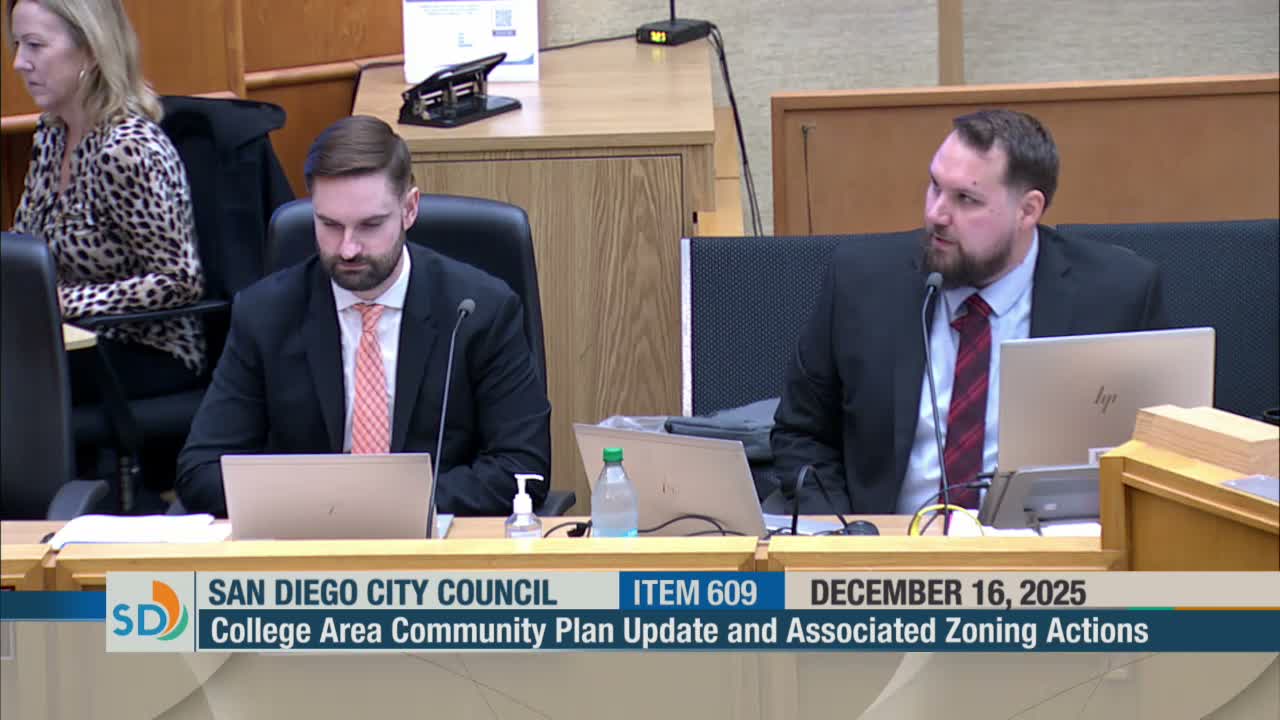
San Diego Council Approves College Area Community Plan Update, Drawing Intense Public Debate
Summary
The City Council approved a major rewrite of the College Area Community Plan to add transit-oriented housing, mobility upgrades and new public‑space requirements; supporters said the plan addresses housing shortages, while opponents warned it risks overburdening parks and emergency services without guaranteed funding.
San Diego City Council on Dec. 2 approved a sweeping update to the College Area Community Plan to increase housing capacity near transit corridors, require new public spaces with infill development and add policies aimed at limiting displacement. Nathan Cosman, senior planner for the city, told the council the draft doubles the community’s planned capacity and identifies a “campus town center” near San Diego State University with pedestrian, bike and transit upgrades.
The plan matters because it aims to ease the city’s housing shortage by allowing higher-density, mixed-use development along College Avenue, El Cajon Boulevard and Montezuma Road while directing new parks, greenways and a proposed linear park on Montezuma to offset growth. Cosman said the update would create capacity for roughly 18,000 additional homes compared with the 1989 plan and that the proposal “seeks to promote vibrant mixed‑use corridors, more housing near jobs and transit, and new public spaces.”
Supporters said the plan is overdue and pragmatic. Councilmember Ilo Rivera, who moved the staff recommendation, emphasized campus‑area housing needs and implementation commitments from the mayor’s office: “Students deserve to be able to live near where they study and graduate,” he said, arguing the plan would reduce overcrowding in private rentals and create long‑term housing options for graduates. Representatives of business and transit groups urged approval, saying concentrating housing near transit would reduce vehicle miles traveled and produce revenue to fund infrastructure.
Opponents, including many College Area residents, warned the draft adds too much capacity without guaranteed parkland, fire stations or school capacity. Julie Hamilton, president of the College Area Community Council, said the neighborhood is “park deficient” and asked the council to reduce horizon densities until land and funding for a rec center, parks and a fire station are committed. Several residents cited wildfire evacuation, parking and the loss of single‑family neighborhood character as reasons for caution.
Council members acknowledged the tensions. Staff and councilmembers pointed to a newly created Community Enhancement Overlay that requires qualifying new developments to provide publicly accessible open space and amenities (or pay an in‑lieu fee). The overlay, adopted later in the meeting, sets a minimum of 5% publicly accessible open space for larger sites and offers incentives for projects that exceed that threshold.
After several hours of public testimony and council debate, the council adopted the College Area plan. The motion passed 7–1, with Councilmember Campillo voting no and Councilmember Von Wilpert absent. Councilmembers and staff said they will continue to work on implementation details — including parks planning, fire‑station siting and funding strategies — and monitor delivery as projects proceed.