Get Full Government Meeting Transcripts, Videos, & Alerts Forever!
Get email alerts on the Climate Action Plan topic
No spam. Unsubscribe anytime.
City reports emissions down from 2019 but warns additional work, funding needed to meet 2030 goal
Summary
City planning staff and the Independent Budget Analyst presented a 2025 status update on San Diego''s Climate Action Implementation Plan, reporting a 19% emissions decline from 2019 but a slight uptick from 2022 to 2023 and urging faster reporting, clearer attribution of reductions and new funding strategies.
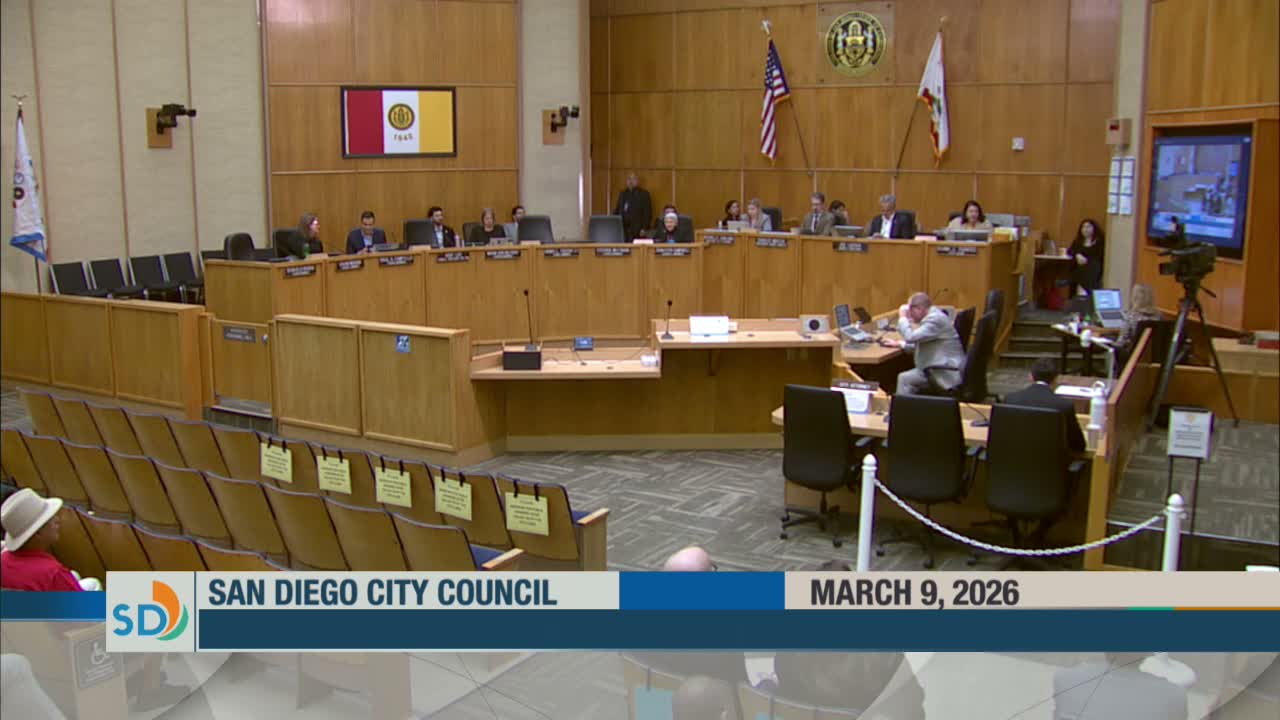
San Diego City Planning Deputy Director Kelly Stonko told the City Council on March 9 that the 2025 status update shows emissions are down about 19% from 2019 but that emissions rose slightly from 2022 to 2023, noting the most recent complete data year is 2023. "Compared to 2019, emissions levels are down 19%," Stonko said.
The update, required in part by a 2024 settlement related to the 2022 Climate Action Plan, reviews the city's emissions inventories, performance indicators and the status of 190 actions in the Climate Action Plan. Stonko said roughly 75% of those actions are underway or complete, and staff are prioritizing actions that are within the city's legal authority and have the largest emissions impact.
Jordan Moore of the Office of the Independent Budget Analyst said the city needs more timely indicators. "Since only being able to judge CAP effectiveness at almost two full years in arrears does not allow for timely oversight," Moore said, recommending shorter reporting windows or additional indicators the council can use to track progress in near real time.
Councilmembers pressed staff on barriers to scaling building electrification and other measures. Councilmember Elo Rivera asked about financial and regulatory barriers; staff cited recent court rulings (for example the Berkeley case) and limited federal funding as key constraints on local building‑code approaches. Staff described steps the city has already taken to pursue alternative financing models, including energy savings performance contracts that can deliver retrofits without large upfront city capital.
The presentation identified transportation (driving and freight) as the largest single source of city emissions, followed by building energy (natural gas and electricity). Staff said renewable content in the electricity mix and year‑to‑year driving patterns were principal drivers of recent emissions changes.
Public commenters, including environmental groups and residents, urged greater transparency, use of the most recent county and regional data where available, and stronger local energy generation such as solar on public rooftops and parking lots. Livia Warak Bowden, counsel for Coastal Environmental Rights Foundation, said the city's report was "disheartening"ly late and urged the city to meet settlement deadlines and use all available emissions data.
Stonko said staff will release the planned annual progress report with updated inventory data this spring and begin the next CAP update in 2026 with anticipated completion in 2027. The presentation emphasized that additional "sweeping changes" will be required across levels of government and the broader economy to meet the plan's 2030 goal.
Next steps: staff committed to improving dashboard detail, to use grant funding from the San Diego Association of Governments to advance an existing‑building decarbonization roadmap, and to pursue alternative funding and partnership models to scale city and community actions.