Get Full Government Meeting Transcripts, Videos, & Alerts Forever!
Get email alerts on the Homelessness topic
No spam. Unsubscribe anytime.
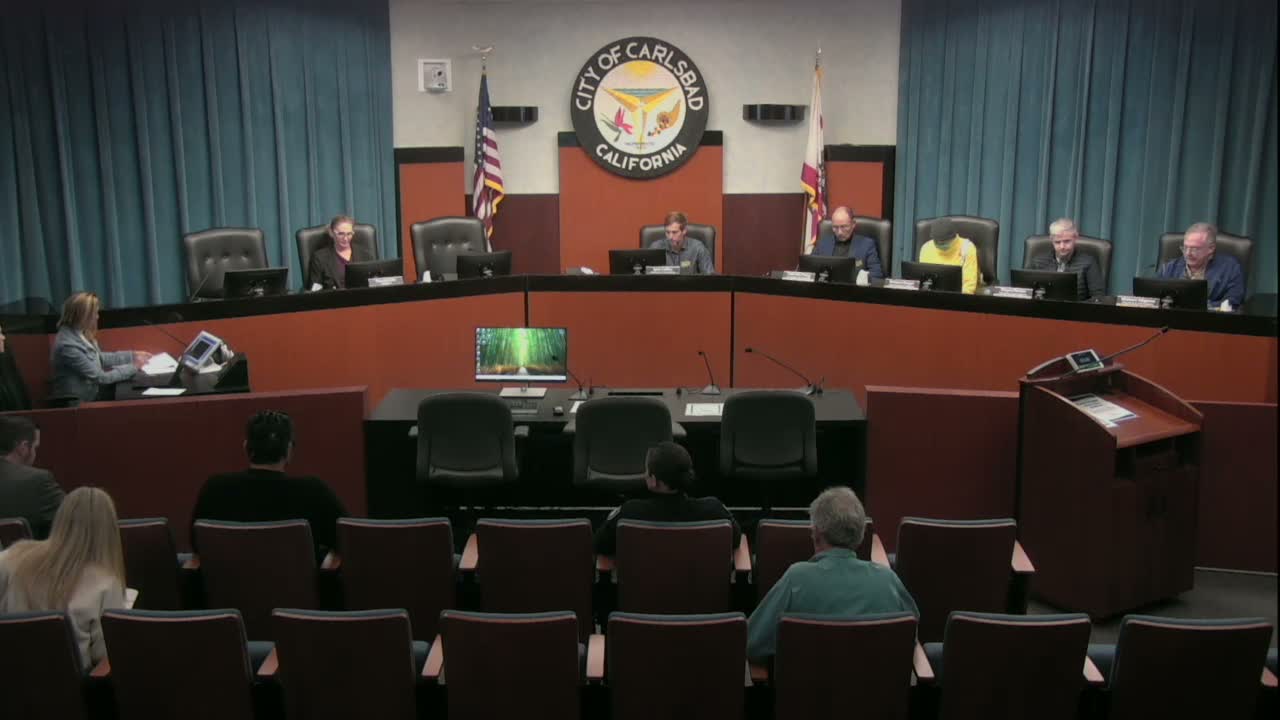
Carlsbad Housing Commission recommends roughly $9.1 million homelessness funding plan and weighs tougher enforcement options
Summary
The Carlsbad Housing Commission on Nov. 14 recommended that City Council approve a FY25–26 homelessness action plan funding package of about $9.1 million, discussed options to change camping and vehicle‑sleeping rules after a recent Supreme Court decision, and accepted new state grants to expand encampment and vehicular outreach programs.
The Carlsbad Housing Commission on Nov. 14 voted to recommend that City Council approve a roughly $9.1 million FY25–26 homelessness action plan funding package after staff presented the annual program report, enforcement statistics and several policy options prompted by a recent Supreme Court ruling.
Chris Schilling, the city’s homeless services manager, opened the presentation by summarizing the homelessness action plan and its four strategies: shelter and housing, outreach and access to services, public safety, and policy engagement. "Our city‑funded programs served 601 unduplicated people and cleaned up 40 encampments," Schilling said, and staff later noted that 133 people entered housing through programs operating in Carlsbad during the year.
Jessica Klein, senior program manager, described the city’s shelter and rapid‑rehousing work: La Posada de Guadalupe provides 50 beds for single men; police and the housing division operate motel voucher programs; and local partners provide prevention and navigation services. Klein said program achievements in the last year included transitioning 89 people into permanent housing, issuing 51 hotel voucher stays and preventing 69 households from entering homelessness.
Lieutenant Sean Lawton of the Carlsbad Police Department presented public‑safety metrics, saying the department received 6,974 calls for service—4,054 officer‑initiated and 2,920 dispatched—with about 6.5% of calls linked to homelessness. He said arrests rose slightly over the period while homelessness‑related citations declined and mental‑health holds increased.
Staff also briefed commissioners on three recent grants that expand the city’s outreach and shelter capacity. Schilling said the city received a $2.3 million encampment resolution grant (three‑year) targeted to the Village/Barrio area around Cole Library, Holiday Park and Pine Park; a regional encampment grant totaling $11.4 million (Carlsbad’s share about $5.3 million over three years) in partnership with Oceanside for the SR‑78/Buena Vista Creek corridor; and a roughly $3 million, three‑year award to start a Vehicular Homeless Outreach Program (VHOP) to address people living in vehicles. Schilling said the VHOP agreement would be taken to City Council for approval in January 2025.
Commissioners probed the point‑in‑time (PIT) count after Klein reported the unsheltered PIT rose from 60 to 112 people year‑over‑year (an 87% increase). Staff cautioned that the PIT is a one‑night snapshot sensitive to volunteer participation and methodology; they noted that other metrics—by‑name lists, unduplicated contacts and program enrollments—give broader context and sometimes show different trends.
The presentation also reviewed legal context following the U.S. Supreme Court’s decision in the City of Grants Pass case, which affects how and when cities may enforce camping bans. Schilling outlined options for the city’s unlawful camping ordinance: keep the current requirement that shelter be offered before issuing a citation; change that language from a requirement to a "best practice"; or remove the shelter‑offer mandate entirely. Staff said other cities in the region have taken different approaches and emphasized the clearance‑with‑support model used locally (notice plus offers of services before removal).
Public comment included a call for stronger enforcement. Resident Robert Lee told commissioners local responses have been "a dismal failure" and described encampment and vehicle‑parking problems in District 1. Terry Jacobs, a District 1 resident who also identified as commission staff, said enough study had been done and urged the Commission to "be really forceful," noting public safety concerns and urging tracking of deaths on the street.
Police Chief Christy Calderwood advocated preserving outreach while giving officers discretion. "I believe that the best option would be to have it be a best practice," Chief Calderwood said about the shelter‑offer language, arguing officers need discretion to address repeat unlawful behavior while continuing to offer services.
After discussion, the Commission considered the FY25–26 funding plan. Schilling and Klein said the city anticipates approximately $9.1 million in homelessness‑related resources next year, driven in part by multi‑year state and federal grants. Chair Collins moved that the Commission recommend City Council approve the funding plan and associated Housing Trust Fund expenditures; Commissioner Berger seconded. The motion passed with four yeas and one recusal. Commissioner Horton recused herself because her employer has a direct relation with the item.
The Commission’s recommendation will go to the City Council for consideration in the new year (staff projected a Jan. 28, 2025 presentation, subject to council calendar changes).