Get Full Government Meeting Transcripts, Videos, & Alerts Forever!
Get email alerts on the Land Use Development topic
No spam. Unsubscribe anytime.
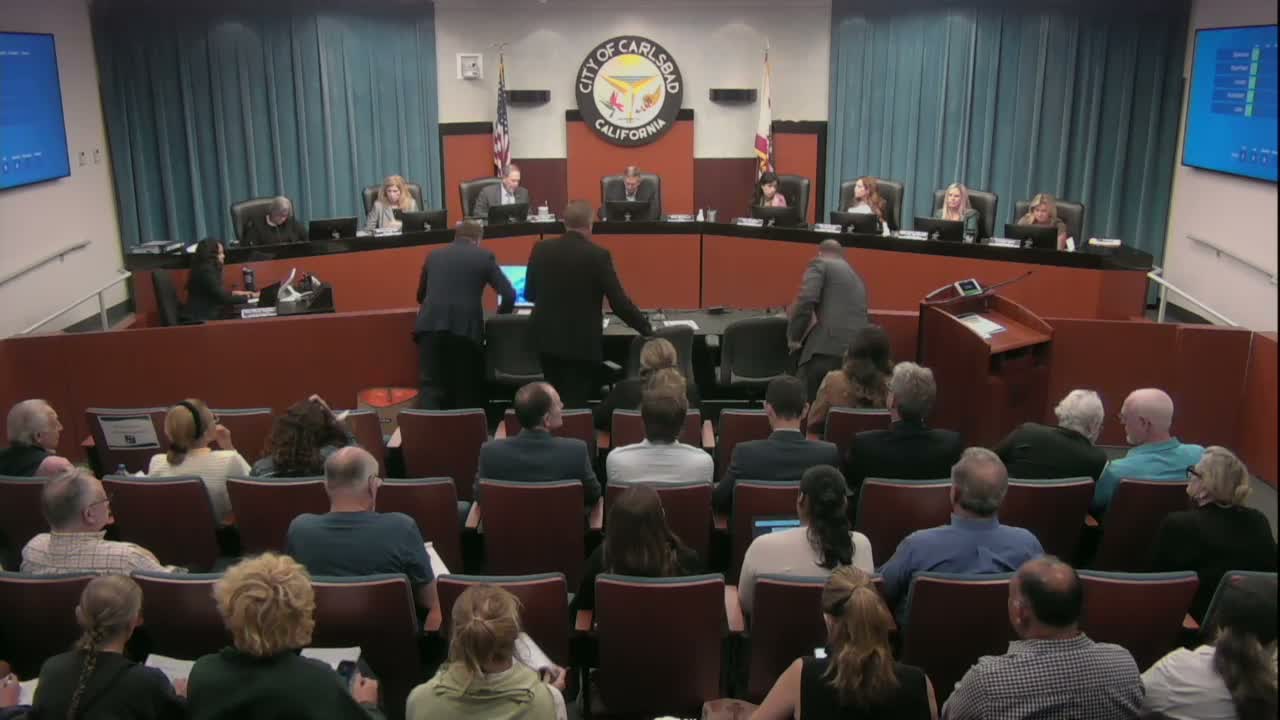
Carlsbad City Council approves Carlsbad Village Drive mixed‑use project with conditions after heated debate
Summary
After nearly five hours of presentations and public testimony, the Carlsbad City Council voted 4–1 to approve a 218‑unit mixed‑use project in the village, adopting amended and new conditions that impose deed restrictions, require certain frontage and commercial build‑out timing, unbundle parking and fund a $50,000 transit subsidy.
The Carlsbad City Council voted 4–1 to approve the Carlsbad Village Drive mixed‑use development, adopting an amended condition and five new conditions intended to preserve commercial commitments and reduce vehicle reliance.
The approved project covers a 4.12‑acre site near the northeast corner of Carlsbad Village Drive and Interstate‑5 and proposes 218 residential units (191 market rate, 27 deed‑restricted very‑low‑income units), about 3,40 on‑site parking stalls in a five‑story parking structure, and roughly 13,800 square feet of one‑story retail. Staff said the city planner posted a CEQA infill exemption for the application on Feb. 29, 2024, and no appeal was filed during the 10‑day appeal window.
City staff framed the decision around recent state housing laws that limit how jurisdictions can deny or reduce density for housing projects. Principal planner Cliff Jones and city planner Jason Gough told the council the Housing Accountability Act, the state’s density‑bonus law and changes to CEQA and VMT guidance constrain local discretion and create legal risk if the city denies a qualifying project.
The council adopted amended condition 12 and new conditions 72–76. Key additions require recording deed restrictions on both project parcels to lock in the residential density and limit future changes; require frontage improvements to be constructed concurrently with residential development; require the commercial portion to be developed within 12 months of issuance of final occupancy for the residential buildings; require that market‑rate unit rents have parking unbundled (parking leased separately); and include a one‑time $50,000 payment from the applicant for transit subsidies for future residents.
Developer Patrick Tooley said the site is in long‑term decline and that the project responds to the city’s Village and Barrio master plan and state housing mandates. “We respectfully ask you to support this project on the recommendation of your staff and your planning commission, and we ask that you vote yes this evening,” he told the council.
Opponents — including many seniors and neighborhood residents — argued the project would remove neighborhood‑serving retail, including a grocery store and pharmacy, creating a hardship for residents who walk to the Village Plaza. “Citizens like myself are banned from the senior center for 9 months on the word of one person,” public commenter Mary Lucid said as she urged the council to hold staff and employees to higher accountability standards; other speakers said losing the grocery would create a local food‑access problem for low‑income seniors.
Technical criticisms focused on the staff VMT screening. Traffic and neighborhood speakers asserted the staff and consultant screening improperly combined residential and retail uses and therefore understated vehicle‑miles‑traveled impacts; they urged either an area‑wide VMT study or additional mitigation. Staff’s transportation reviewer described the project as meeting multiple VMT screening criteria (transit proximity, locally serving retail and redevelopment), concluding no further VMT analysis was required under the city’s VMT guidelines.
Council debate mixed procedural and policy concerns. Several council members said they resent state preemption of long‑standing local growth‑management rules but concluded the legal risk of rejection was substantial. Councilmember Burkholder said the project is “too much for this property” and cast the lone no vote; the motion to adopt the resolution and the conditions passed 4–1. Mayor Blackburn, Councilmembers Luna, Acosta and Mayor Pro Tem Bob Patel voted in favor.
Separately, council directed staff to return with revisions to Council Policy 84 (outreach requirements) and amendments to chapter 19.04 of the municipal code so that CEQA exemptions for permit‑level decisions would be considered by the decision‑maker for the permit rather than left solely to the city planner.
The project’s approval does not end the process: the council’s action adopted the project resolution and conditions; the applicant must meet the conditions, finalize entitlements and satisfy any recordation and construction‑phase requirements before building can proceed.