Get Full Government Meeting Transcripts, Videos, & Alerts Forever!
Get email alerts on the Climate Action Plan topic
No spam. Unsubscribe anytime.
Carlsbad council approves a pared-back climate plan but adds city-owned solar carports; TDM review ordered
Summary
After a lengthy public hearing with competing business and environmental testimony, the Carlsbad City Council adopted a narrowed climate action plan option while directing staff to install municipal solar carports and evaluate transportation-demand-management rules; the core CAP certification also passed.
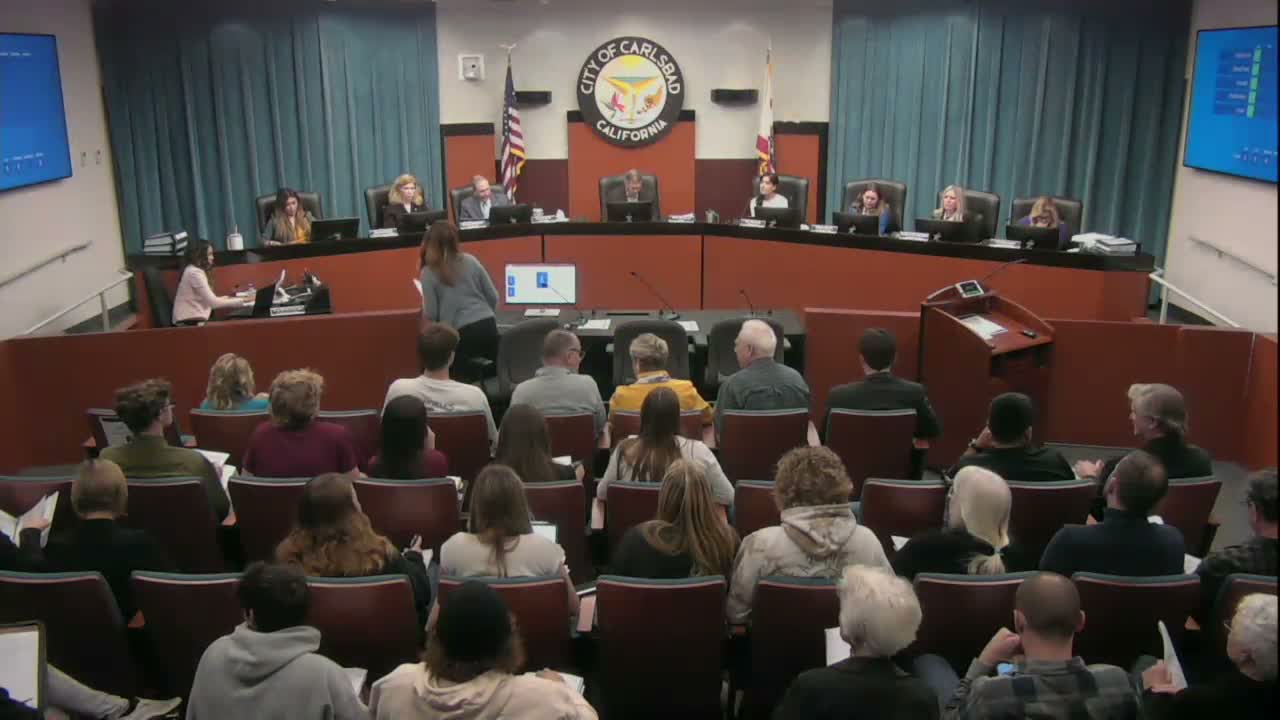
The Carlsbad City Council on Nov. 12 adopted a version of the city's updated Climate Action Plan that excludes three proposed REACH-code measures but directs staff to implement solar carports with battery backup on city-owned parking lots and to evaluate the city's Transportation Demand Management (TDM) thresholds.
Council heard more than two dozen public speakers during a nearly three-hour public hearing that included environmental advocates pressing for stronger electrification measures and representatives of business and building-industry groups warning that some REACH-code provisions could be costly or legally risky. Staff's senior program manager Katie Hentrich reviewed four adoption options that ranged from meeting the state 2045 reduction target to adopting the full draft CAP (which would exceed targets by roughly 6,000 metric tons CO2e). The council's approved motion followed a compromise approach: adopt Option 1 (the plan excluding three specific REACH measures) and add a municipal solar-carport program for city lots.
Nut graf: The decision balances competing priorities that surfaced repeatedly in public comment: environmental advocates asked the city to keep building-electrification measures in place to protect public health and meet ambitious greenhouse-gas reductions; business and development representatives asked for greater analysis of cost impacts and legal exposure from aggressive local reach codes. The council chose a middle path that keeps the CAP update on track while adding a city-led solar-carport commitment and ordering staff analysis of TDM rules intended to avoid unintended barriers to business expansions.
Council and staff said the CAP remains a multi-decade implementation program with monitoring benchmarks and annual reports that will enable adjustments. Staff emphasized that the California Energy Commission (CEC) requires a cost-effectiveness demonstration before any local REACH-code adoption; if a future CEC review finds a proposed REACH code not cost-effective, the city would not implement it.
During the meeting, staff outlined the CAP's structure: 25 measures with 37 primary actions and 69 supporting actions; the city baseline is a 2016 greenhouse-gas inventory of about 981,000 metric tons CO2e. Options presented varied in whether to include nonresidential and residential REACH-code measures and whether those additions would exceed the city's 2045 reduction target by roughly 200 to 6,000 metric tons.
Public testimony illustrated the division: conservation groups and Clean Energy Alliance advocates urged Option 4 (adopt the full draft), highlighting co-benefits for health and urging early adoption of solar carports and distributed energy resources. Industry and business speakers' including representatives of the San Diego Regional Chamber, BOMA San Diego, the California Apartment Association, and the Building Industry Association'urged adopting the staff-recommended Option 1 or a narrowly tailored approach and requested more detailed private-sector cost analyses and alternative compliance approaches.
In the end, the council voted to adopt Option 1 with the added municipal solar-carport directive; the main motion passed 4–1, with Councilmember Acosta voting no and urging the council to go further. The mayor's companion minute motion directing staff to evaluate the TDM ordinance's thresholds passed 3–2. The council also unanimously adopted a separate resolution certifying Addendum No. 1 to the environmental analysis for the CAP update.
What happens next: Staff will update the CAP documents to reflect the council's choices, perform any required CEC cost-effectiveness analyses before pursuing REACH-code adoption, begin work on municipal solar-carport feasibility and battery/charger design and schedule, and include progress updates in annual CAP monitoring reports. The city intends to finalize the CAP implementation steps and maintain an online dashboard to track measure status.
Representative quotes: "We must continue to focus on waste reduction, composting, and reuse," Councilmember Carolyn Luna said during proclamations earlier in the meeting. (Councilmember Luna spoke in other agenda contexts.) "If other measures stall, not having enough updates will hinder our ability to meet targets," said Anthony Ding of Climate Action Campaign during public comment, urging Option 4. "Adoption of Option 1 plus municipal solar carports gives us a practical path forward while still making the city a leader," Mayor Blackburn said as he moved the compromise motion.
Ending: Council's action leaves Carlsbad with an updated CAP that meets the 2045 target under Option 1, an explicit municipal solar-carport commitment and a staff assignment to revisit TDM thresholds. Staff will return with implementation details and monitoring benchmarks as the city proceeds to put the adopted measures into practice.