Metropolitan Nashville Public Schools presents FY2027 budget proposal with $12 million operating increase and major student‑support investments
Loading...
Summary
At a finance committee meeting, MNPS staff proposed a FY2027 budget that adds $12 million for continued operations and lists aspirational investments including pay increases, school health clinics, student success centers and a large cybersecurity upgrade; officials said the plan depends on city allocations and is preliminary.
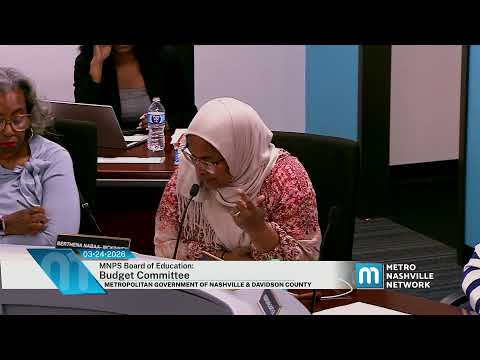
Metropolitan Nashville Public Schools officials laid out a proposed fiscal year 2027 operating and aspirational budget at a board finance committee meeting, pitching a $12,000,000 increase to sustain district operations and a slate of outcome-driven investments aimed at student supports and workforce retention.
Dr. Battle, who opened the meeting, framed the discussion around recent achievement gains: “we are currently, still celebrating and learning from, having the highest CCAB and ELC scores in our district history,” she said, adding that the district has seen double-digit increases in proficiency since 2021 and historic graduation rates.
Chief Robles said the operating proposal includes a $12 million continuity increase and a series of aspirational items that would be funded only if additional revenue is available. “In terms of the operating budget, we're looking at a $12,000,000 increase, to sustain, or to provide continuity,” he told the committee.
Why it matters: Robles told board members MNPS’s funding mix has shifted toward local sources (about 74% local, 18% state, per the presentation) and that state policy choices — including charter approvals and an expanded ESA voucher program — have reduced the funds available to the district by an estimated $11,000,000 annually. That fiscal pressure was offered as the context for prioritizing core services and seeking outside funding to support new initiatives.
Key dollar items and program priorities described by staff included: • A $12,000,000 increase labeled as continued operations to cover contractual increases, utilities and inflationary costs. • Salary-related investments (a 1% cost-of-living adjustment the presentation estimated at about $6,800,000 split between certificated and support staff; and an annual step/compensation package discussed as part of the talent strategy). • Targeted academic investments: $10,500,000 for academic acceleration; roughly $1,300,000 to expand high‑demand pre‑K seats (Hillwood Early Learning Center); $700,000 for visual and performing arts; and other targeted sums for advanced academics and differentiated-learning supports. • Talent and workforce programs: $5,800,000 to expand classroom associates, $1,300,000 for a district-run “grow your own” educator-preparation program, increased stipends and differentiated pay to aid recruitment and retention. • Positive school supports and safety: $7,000,000 for preventative facilities maintenance; approximately $9,200,000 to open four school‑based health clinic sites (presented as about $2,300,000 per site); nearly $11,000,000 for student success centers; $3,000,000 for security enhancements; and a cybersecurity line item shown in the presentation at $150,000,000 described by staff as an aspirational, growing‑need investment. • A modest initial investment to create in‑house philanthropic capacity (presentation listed $200,000) and $300,000 for financial‑planning capacity to leverage funding across sources.
Board questions and staff clarifications: Committee members pressed staff for placement of existing services and timing. In response to Board member Taylor asking whether advocacy centers and peace centers appear in the budget, staff said those supports are already funded through school budgets and represented in the district’s continuity‑of‑operations figures. On before‑and‑after‑care, staff said the $2,000,000 aspirational item is intended both to respond to longstanding access needs and to help families adjust to planned school start‑time changes.
Several members asked how student success centers would differ from current advocacy centers or alternative learning centers (ALCs). Dr. Battle described the success centers as short‑term, restorative intervention sites that are closer to students’ communities and intended to help students return to their school of choice sooner, with supports for families and re‑entry rather than long‑term exclusionary placements.
Philanthropic capacity: Board members asked how a new philanthropic arm would differ from existing local partners such as Pencil and the Nashville Public Education Foundation (MPEF). Staff said the proposed in‑house capacity would focus on grant writing, donor coordination and aligning outside funds to board priorities; the presentation described it as complementary to, not duplicative of, current partners.
Process and timing: Staff said the same budget materials would be shared with the public the following day and the proposal would return to the board for consideration on April 14; a detailed line‑item budget would be presented after the mayor submits an ordinance and Metro Council determines the MNPS allocation, with final approval targeted for June.
What remains tentative: Several cost items presented were explicitly described as estimates and contingent on external approvals — for example, health‑insurance and pension increases were given as estimated figures and Robles noted those amounts are “not amounts that have been approved yet by the governing bodies.” The large cybersecurity figure shown in the aspirational list was presented as an estimate in the aspirational portfolio and would depend on funding availability.
The committee closed with a reminder that school‑level budgets and the meeting recording are posted on MNPS’s budget site and YouTube channel; staff invited the public to a community session the next day for further questions.