Commission staff unveils proposed SB 1 workforce-reporting framework, attendees raise data and accountability concerns
Loading...
Summary
Commission staff proposed a two-part update to SB 1 program guidelines to standardize reporting on jobs, wages and workforce partnerships (Part A: quantitative prompts; Part B: qualitative narrative). Stakeholders welcomed equity language but raised feasibility and timing concerns for data and accountability.
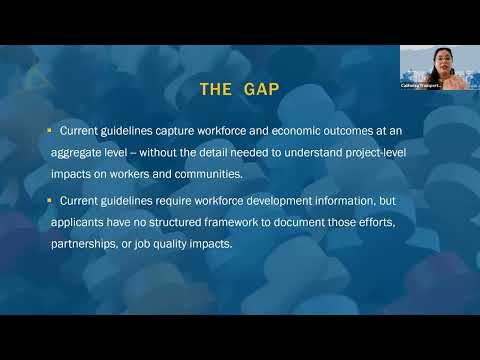
Commission staff for the Transportation Commission outlined proposed updates to SB 1 program guidelines that would ask applicants to document both quantitative job-related details and a qualitative "workforce story" linking projects to regional workforce systems. Naveen Habib, manager for the Solutions for Congested Corridors program, presented the two-part framework during a public workshop and said the goal is to give the commission a "more complete and consistent picture across the entire SB 1 portfolio."
The proposed changes split responses into Part A, which would require applicants to estimate numbers and types of jobs (construction-phase, long-term operational, indirect), prevailing-wage determinations and wage progression, geographic reach into economically distressed areas, workforce partnerships, and targeted outreach to workers facing structural economic barriers; and Part B, which would require narrative description of advancement pathways, multiplier effects, and how projects connect to the regional workforce ecosystem. "Part A structures the existing jobs and economic development questions into five potentially required prompts," Habib said.
Commission staff emphasized the update is intended to clarify and standardize information the guidelines already ask for, not to create new social programs. "We're not adding any social programs," Habib said. "We're asking applicants to document the workforce and economic outcomes that their transportation projects generate."
Attendees broadly welcomed explicit equity language. "Thank you for including language on formerly incarcerated individuals," said Marissa Brown, senior program manager of transportation equity at the Greenlining Institute, who urged tracking both job quantity and job quality.
But multiple implementing agencies raised practical concerns about data availability and timing. "I'm having mixed feelings," said Akiko Yamagami of LA Metro, noting that project teams often scramble to assemble economic-analysis data during application preparation and that some project phases may not yet have project-level economic studies. Other attendees asked whether applicants would be accountable if projected job numbers did not materialize.
Matthew Yaskott, deputy director of SB 1 programming, said the prompts are intended primarily for documentation and to signal priorities to applicants; staff do not intend to convert these prompts into mandatory performance metrics for the immediate cycle. He pointed to the commission's existing accountability and transparency practices, including a requirement for a qualitative project performance analysis five years after a project opens, and said data-generation methods are still under consideration with state partners. "The tangible data side of things may not be there quite yet," Yaskott said.
Staff also addressed definitional and methodological questions: they plan to rely on partner definitions (for example, guidance from the California Workforce Development Board) for terms such as "economically distressed," and are considering pointing applicants to Caltrans methodologies for estimating job creation where feasible. For multiplier effects and supply-chain impacts, staff said Part B expects qualitative narrative; defensible, observable claims are preferred to hypotheticals.
On schedule, staff told attendees that draft guidelines will be presented at the commission's June meeting, revisions would occur in July, and commissioners would vote on final guidelines in August; if adopted, the commission would open the call for projects for 2026. Staff also noted office hours through May and a series of follow-up workshops.
Next steps: staff said they will take the public feedback into account, continue discussions with Caltrans and workforce partners on methodology and feasibility, and return draft language for review before final adoption. "We will take everything we've heard today under consideration," Habib said, and encouraged attendees to submit resources and examples to inform future guideline language.