Panel split over how to allow out‑of‑state counselors to provide short continuity of care
Loading...
Summary
House Bill 1483 would permit limited continuity‑of‑care telehealth services from out‑of‑state licensed counselors for patients newly residing in Maryland; sponsor favored a limited‑licensure exception while boards urged temporary licensure to preserve oversight and enforcement.
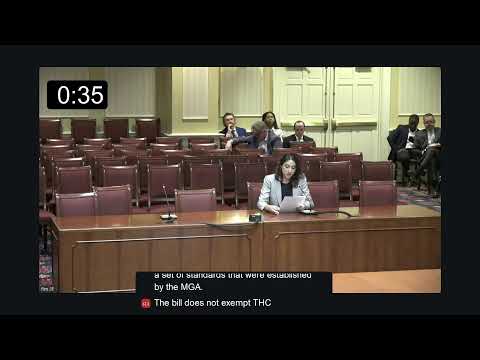
Delegate Kaiser and supporters told the Senate Finance Committee that House Bill 1483 seeks to preserve continuity of mental‑health care for people who relocate to Maryland by allowing out‑of‑state fully licensed counselors with an established counselor‑client relationship to provide a limited number of telehealth sessions while the patient transitions to Maryland care.
The bill’s sponsor and supporters said the measure was modeled in part on Virginia’s 2022 continuity‑of‑care law and that the House approved the bill 135–0. They presented two implementation approaches considered during the House process: a limited licensure exception for a short continuity window or a temporary license issued by Maryland boards. The sponsor said the bill aims to ensure continuity for people arriving in Maryland for military service, school or work and that it does not put Maryland residents at risk when executed with proper disciplinary referral channels.
Representatives of the Licensed Clinical Professional Counselors of Maryland (Sarah Trescott) and Manus Canning (Andrea Mansfield) urged that a temporary license better protects patients and allows Maryland to investigate complaints; Trescott asked who would issue a license at 3 a.m. if a suicidal client crosses into Maryland in crisis, arguing timeliness matters. The Board of Professional Counselors (Tomilo Bolani Kodri) and the Board of Social Work Examiners (Kevin Menon) supported continuity of care in principle but recommended retaining temporary licensure and expressed concern that a licensure exception without registration would weaken Maryland’s ability to protect residents.
Senators questioned boards about staffing and online licensing capacity; boards acknowledged delays caused by paper applications and limited licensing coordinators and said an internal online workaround and hiring of licensing coordinators were planned. The board’s executive director said MDH controls the permanent automation timeline. Sponsors and boards discussed tradeoffs between rapid access in crises and sustained enforcement authority.
No committee vote occurred in the hearing. The bill’s supporters urged a favorable report and indicated willingness to refine implementation language to address oversight, complaint referral and processing time. The hearing record shows a split on the administrative mechanism — limited licensure exception versus temporary license — but agreement on the policy goal of preserving established therapeutic relationships during short relocations.