Get Full Government Meeting Transcripts, Videos, & Alerts Forever!
Get email alerts on the Mobile Food Ordinance topic
No spam. Unsubscribe anytime.
Cotati planning commission backs ordinance setting rules for food trucks, carts and parklets
Summary
The planning commission voted unanimously to recommend the City Council adopt an ordinance adding standards for sidewalk vendors, food trucks and carts, parklets, outdoor dining and related home-occupation and urban-agriculture rules; commissioners asked staff to extend industrial-zone vending to two hours and tighten wastewater-disposal language.
The Cotati Planning Commission unanimously voted to recommend that the City Council adopt an ordinance adding citywide standards for food and mobile businesses, including sidewalk vendors, food trucks and carts, parklets, outdoor dining and certain home-occupation and urban-agriculture uses.
Autumn, a community development staff member presenting the draft, told the commission the proposal "is to foster economic development and community vitality while managing potential impacts from these uses." The draft covers a wide range of mobile-food activity and proposes rules intended to keep vending safe and temporary while complying with state law.
Key provisions in the draft and the commission's recommended changes include: sidewalk vendors operating only on public sidewalks with a city business license (food vendors must also have a county health permit), a 4-foot clear pedestrian path requirement, a 25-square-foot limit for vendor footprint, and operational-hour bands by zone (for example, residential hours were discussed separately from commercial hours). Staff also reiterated that fines must follow state law and cited a three-step fine sequence (for example, $100, $200 and $500 for repeated infractions within a calendar year) and an ability-to-pay determination process.
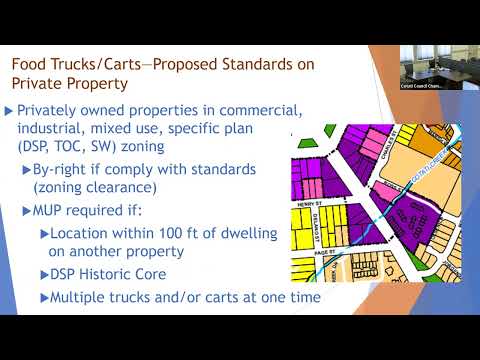
The draft treats food trucks and carts differently from sidewalk vendors. Staff proposed baseline requirements (business license, health permit, restroom access for stationary vendors, litter control, noise and odor performance standards) and additional rules when trucks or carts operate on private property, including a 100-square-foot cap for carts and nightly removal of equipment unless a permit allows otherwise. For intermittent street parking in the commercial-industrial area, staff described limits such as a 60-minute maximum on the street with a required move of at least 500 feet and special operating windows intended for employee vending.
Commissioners raised practicality concerns about short time limits. Chair Long said, "I kind of agree with Kimberly that the 1 hour limit and definitely the 30 minute limit makes it pretty much, like, a no go for most operators," noting setup and breakdown times reduce the time available to serve customers. Staff acknowledged a slide/report discrepancy on timing and confirmed the draft code language allows 60 minutes on the street and one hour total on a private property for intermittent operations, and that staff would clarify the text.
Commissioners also pressed staff on music and wastewater enforcement. On amplified music, staff said amplified sound would generally require a use permit and enforcement would rely on existing noise/decibel standards; on wastewater, at least one commissioner urged changing permissive wording ("refrain") to prohibitory language ("prohibited") and asked staff to confirm whether other agencies have enforcement authority for wastewater dumping.
A Zoom public commenter, Jessica, urged the commission to extend vending windows, saying she favored "extending it a couple hours" to make operations practicable and objected to derogatory terms for vendors.
After discussion, a commissioner moved that the planning commission adopt a resolution recommending the City Council adopt the ordinance as drafted but with specific recommendations: increase the time allowance in industrial zones to two hours, allow regular food-truck business hours until 11 p.m. or until the affiliated business's closing time, and strengthen the wastewater-disposal language to be more prohibitory. Another commissioner seconded the motion. The commission then voted and the motion passed unanimously.
Votes at a glance: motion to adopt the planning commission's resolution recommending the Council adopt the ordinance with the commission's amendments — passed (5–0; recorded votes: Commissioner Sparks, Aye; Commissioner Berman, Aye; Commissioner Moffitt, Aye; Vice Chair Gilardi, Aye; Chair Long, Aye).
The resolution and staff's finalized code language will be transmitted to the City Council for its consideration; staff also said it would correct slide/report inconsistencies, follow up on interagency wastewater enforcement questions, and bring refined language as the ordinance moves to the council. The meeting then turned to routine staff and commissioner reports and adjourned.