Get Full Government Meeting Transcripts, Videos, & Alerts Forever!
Get email alerts on the Public Health Tobacco Policy topic
No spam. Unsubscribe anytime.
Committee forwards proposed tobacco-retailer code changes, including end to "healthy foods" exemption
Summary
The Law & Legislation Committee voted unanimously to forward proposed revisions to Sacramento City Code chapters 5.138 and 9.12 — including sunsetting the 2020 "healthy foods" exemption and increasing tobacco‑retailer licensing fees — to the full City Council for consideration, after months of debate and extensive public comment from health advocates and business owners.
The Sacramento City Council Law & Legislation Committee voted unanimously to forward proposed revisions to the city's tobacco retail licensing code to the full City Council, including a staff recommendation to end the 2020 "healthy foods" exemption that has allowed some new tobacco retailer licenses.
The staff presentation, delivered by Sean Bartosz, code enforcement manager with the Community Development Department, outlined several changes: ending the healthy‑foods exemption for future transfers while grandfathering existing holders who maintain licensure, clarifying definitions (including "characterizing flavor," shisha and flavor enhancers), creating a presumption that flavored tobacco found on premises is offered for sale, strengthening inspection enforcement (including suspension for denying inspections), aligning the legal purchase age to 21, and raising licensing fees to approach full cost recovery.
"The healthy foods exemption sunset. This will end the healthy foods exemption," Bartosz said in his presentation, and he told the committee a fee study shows the TRL program costs about $260,000 annually and would require raising the new‑license fee to about $909 and renewal to $759 to reach cost recovery.
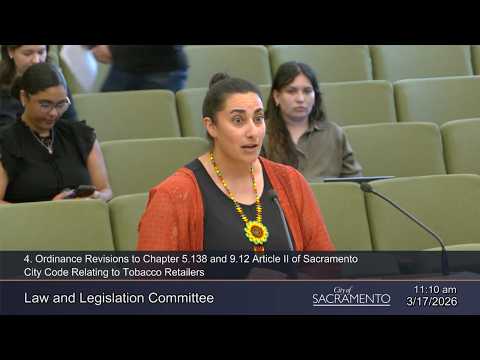
Why it matters: public‑health advocates said the exemption undermined the 2019 flavored‑tobacco ban and increased retailer density in neighborhoods already bearing tobacco‑related health burdens. Rachel Alvarez, vice chair of the Greater Sacramento Smoke and Tobacco‑Free Coalition, thanked the committee for revisiting the ordinance and said the coalition "strongly supports the amendments proposed by city staff." Public‑health testimony also cited an academic in‑store study showing low compliance among exemption users.
Business owners and petroleum/convenience trade representatives urged caution. Several convenience and gas‑station owners said tobacco sales account for significant revenue and warned that nontransferability or a strict 1,000‑foot proximity rule could render some sites unsellable or sharply reduce business value. "Tobacco makes up 30% of convenience‑store sales," said a local gas‑station owner, arguing the ordinance should preserve a clear pathway to sell or transfer a business.
Committee action and next steps: Council member Dickinson moved to forward the ordinance package to full council while specifically highlighting the transferability issue for council discussion; the committee approved the motion unanimously. The committee did not adopt a final ordinance at this meeting; staff told members that the packet listed an April effective date tied to internal timelines but that council scheduling could push an effective date toward June.
What staff said on enforcement and fees: Bartosz said the code changes clarify enforcement authority (including presuming that flavored products on premises are for sale), provide stronger remedies when a retailer obstructs inspections, and adjust language in Title 9 to match state age limits. He also compared Sacramento's proposed TRL fees to other Northern California jurisdictions and said some cities charge as much as $2,500 for a new license.
Public response and council concerns: The committee heard repeated requests to distinguish between smoke shops (primarily tobacco retailers) and conventional convenience stores or gas stations; business representatives asked for exemptions or grandfathering tailored to larger capital‑intensive operations. Several council members said they support reducing tobacco availability for youth and equity reasons but are sensitive to the economic impacts on smaller, often family‑owned businesses and asked staff to return with additional details or alternatives on transferability and mitigation options.
What happens next: The ordinance package will go to the full City Council for further consideration, with staff and council members flagged to return with additional analysis of transferability, compliance data, and a clarified timeline for implementation.