Get Full Government Meeting Transcripts, Videos, & Alerts Forever!
Get email alerts on the Education topic
No spam. Unsubscribe anytime.
Lyon County board narrows district performance plan to three priorities, sets attendance target
Summary
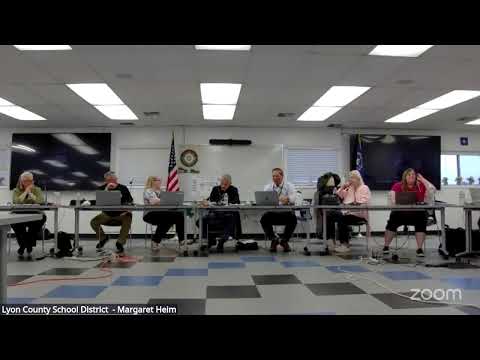
At a March 26 workshop the Lyon County School District Board of Trustees cut its district performance plan from eight goals to three priorities — chronic absenteeism, K–8 growth via i‑Ready, and a MAP median target for grades 9–10 — and set numeric targets to present to the state.
The Lyon County School District Board of Trustees on March 26 narrowed its district performance plan to three measurable priorities and set preliminary numeric targets to present to the Nevada Department of Education.
At a workshop in which district staff reviewed midyear data, Superintendent Tim Logan and data staff urged the board to pare back eight previously proposed goals so schools could pursue a more focused set of objectives. "If everything's important, nothing's important," Logan said as he urged a smaller list the board could realistically monitor.
Deputy Superintendent Stacy Cooper framed the discussion with an overview of the Nevada School Performance Framework (NSPF), noting the district must align its district performance plan and individual school performance plans to state requirements under federal ESSA. Cooper also told the board that the NSPF designates some schools for additional support: "We currently have two schools that are in CSI status — Fernley Intermediate School and Silver Stage Elementary School," she said, and explained CSI/ATSI/TSI classifications carry multi‑year improvement expectations.
Executive director Jim Gianotti presented midyear progress on the eight goals the district set for 2025–26. He said the district recorded 58,383 career and work‑based learning activities to date and reported a districtwide graduation rate of 85.73 percent. Gianotti also told trustees that WorkKeys curriculum is now in place at each high school and that the district’s chronic absenteeism rate had improved from 30.7 percent to 25.5 percent between the February checkpoints mentioned in his presentation.
Board members and administrators focused on measurement and fairness. Several trustees argued last year’s goals had been too numerous and in some cases too aggressive, creating the risk that schools with different starting points would be unfairly penalized. Trustees favored goals that are data‑driven, achievable and flexible enough for site teams to implement. "We need to let these schools do it the way they feel to meet their goals," one trustee said, urging respect for school‑level plans.
After extended discussion and input from school principals in the audience, the board reached consensus on three district priorities to include in the district performance plan to be submitted to the state: reduce chronic absenteeism districtwide; raise K–8 student growth measured via i‑Ready; and maintain a median MAP percentile of 50 or higher for grades 9–10. The board set preliminary numeric targets tied to the 2025–26 baseline: a 2.5 percent reduction in chronic absenteeism and a 2.5 percent increase on the chosen i‑Ready/K–8 growth metric; the MAP target is to maintain a median percentile at 50 or above for grades 9–10. Staff will finalize wording and exact baselines before the formal DPP submission.
Trustees stressed that the narrowed district goals do not end other initiatives: Gianotti and Cooper said work‑based learning, CTE endorsements and other programs will continue but no longer occupy separate district goal slots because they are already underway. Principals from multiple schools told the board they preferred the smaller set of goals. "Less goals — less goals," one principal said when asked for feedback. Assistant principals and school leaders added that the narrower plan will make it easier to write SPPs and align local stakeholder objectives to district priorities.
Procedurally, the board approved the workshop agenda at the start of the meeting; that motion passed unanimously. No final, formal board vote adopting the district performance plan was recorded at the workshop; the board asked staff to present the final DPP language and baselines at an upcoming meeting and to send the agreed framework to the state on the timetable Cooper described.
The board will review final DPP language and site SPPs in June, after state and local assessment windows close and staff can confirm baselines. Superintendent Logan said the district will present the agreed three‑goal framework to the Nevada Department of Education and return to the board with the finalized targets, sample school performance plans and any related policy language.
• Votes at a glance: the workshop agenda was moved and seconded and "passed unanimously" at the start of the meeting; the narrowing of goals was approved by board consensus and recorded for staff to formalize but was not taken as a roll‑call motion during the workshop.
The district will present the finalized district performance plan and accompanying policy items at an upcoming board meeting; the board will also receive a budget preview and first/second readings of several policies in April and May.