Get Full Government Meeting Transcripts, Videos, & Alerts Forever!
Get email alerts on the Public Comment topic
No spam. Unsubscribe anytime.
Residents and service providers urge housing‑first responses, safe camping and better wraparound services at Stockton session
Summary
At a City Council study session, more than a dozen residents, nonprofit leaders and people with lived experience urged Stockton to prioritize Housing First, safe camping/parking with services, storage and humane property handling rather than punitive sweeps in response to Grants Pass v. Johnson.
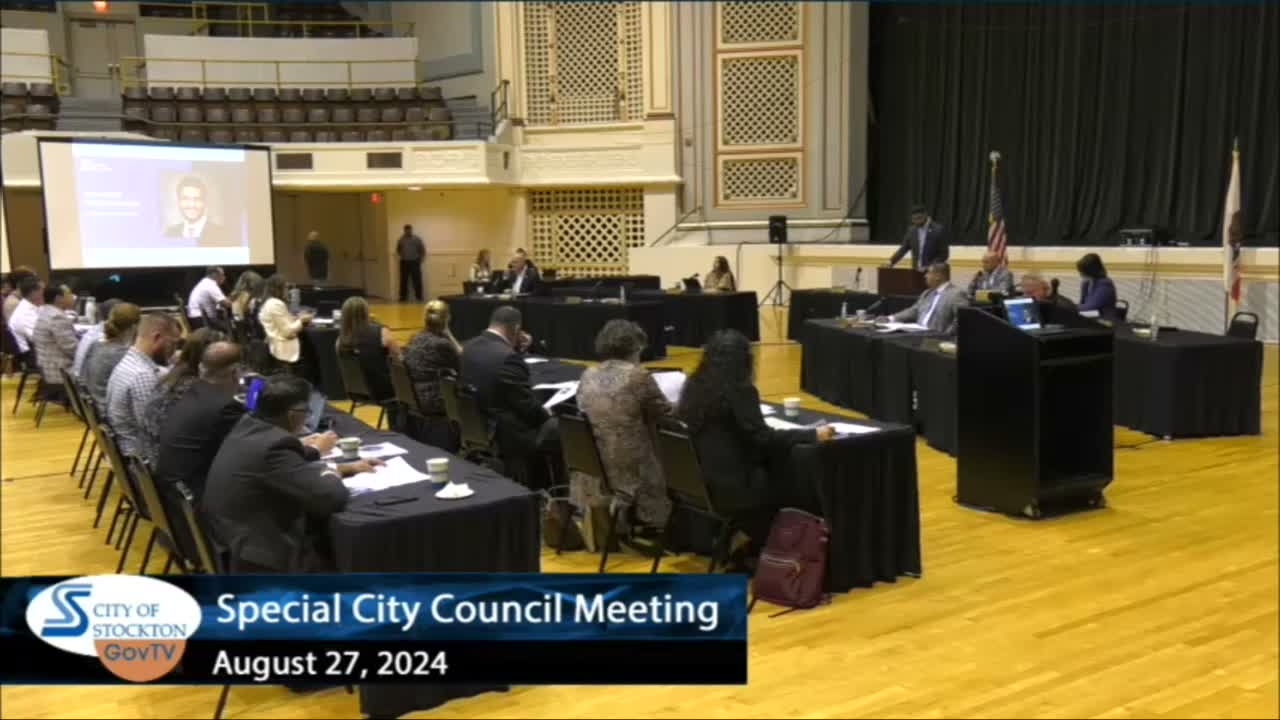
Scores of residents, service providers and people with lived experience addressed the Stockton City Council during a lengthy public‑comment period on Aug. 27, urging humane, housing‑first responses as the city considers new enforcement options after the Grants Pass v. Johnson Supreme Court ruling.
Speakers from local nonprofits and advocacy groups emphasized wraparound services and diversion over sweeps. Ruby Lockhart, CEO of Heart to Heart Ministries, described regular outreach and basic supplies distribution and warned that children live in encampments, calling for collaboration and compassion. “They need housing, but these things are to come...we should give the people out there an opportunity to have a sustainable life and not just throw things their way,” she said.
Service providers highlighted capacity limits and barriers. Jessica Velez (Red Rabbit Advocacy) said empty apartments exist but many households cannot qualify for vouchers because of income‑qualification thresholds; she said shelter‑plus and transitional options are needed and that additional service coordination (hospitals, mental health) would reduce recurring shelter recidivism. John Mendelson (Central Valley Low Income Housing Corporation) noted data showing many households enter shelters each year but far fewer move into permanent housing because of capacity constraints.
People with lived experience described the on‑the‑ground consequences of cleanup operations and property handling. Ashley Petri, who said she is homeless with six children, said personal belongings have been lost during cleanups and asked why property stored after sweeps is sometimes unrecoverable. Mitchell Badu recounted recurring cleanups that move people without ensuring they can be reached by outreach teams afterward. Several commenters urged safe‑parking and safe‑camping sites with hygiene services, laundry and on‑site case management so residents can stay together and access supports.
Advocates also warned about unequal enforcement outcomes. Fred Shield (Housing Justice Coalition) said enforcement could push unhoused people into neighborhoods where complaints are less likely to surface, effectively making them invisible to services. Multiple speakers asked the city to use trauma‑informed approaches, coordinate with smaller nonprofits, and ensure disability‑specific supports are available.
What the council heard and asked for: council members repeatedly thanked speakers and said staff will incorporate public input into policy options. Several councilmembers specifically asked staff to consider pet accommodations in shelter or campus designs (Pathways will allow pets; the navigation center is still being evaluated) and to explore permanent hygiene solutions at proposed camping or parking sites.
Ending: Public commenters concluded before the staff presentations began; council asked staff to return with phased options that reflect community priorities, including safe camping/parking models, operator options and funding pathways.