Get Full Government Meeting Transcripts, Videos, & Alerts Forever!
Get email alerts on the Mobile Response topic
No spam. Unsubscribe anytime.
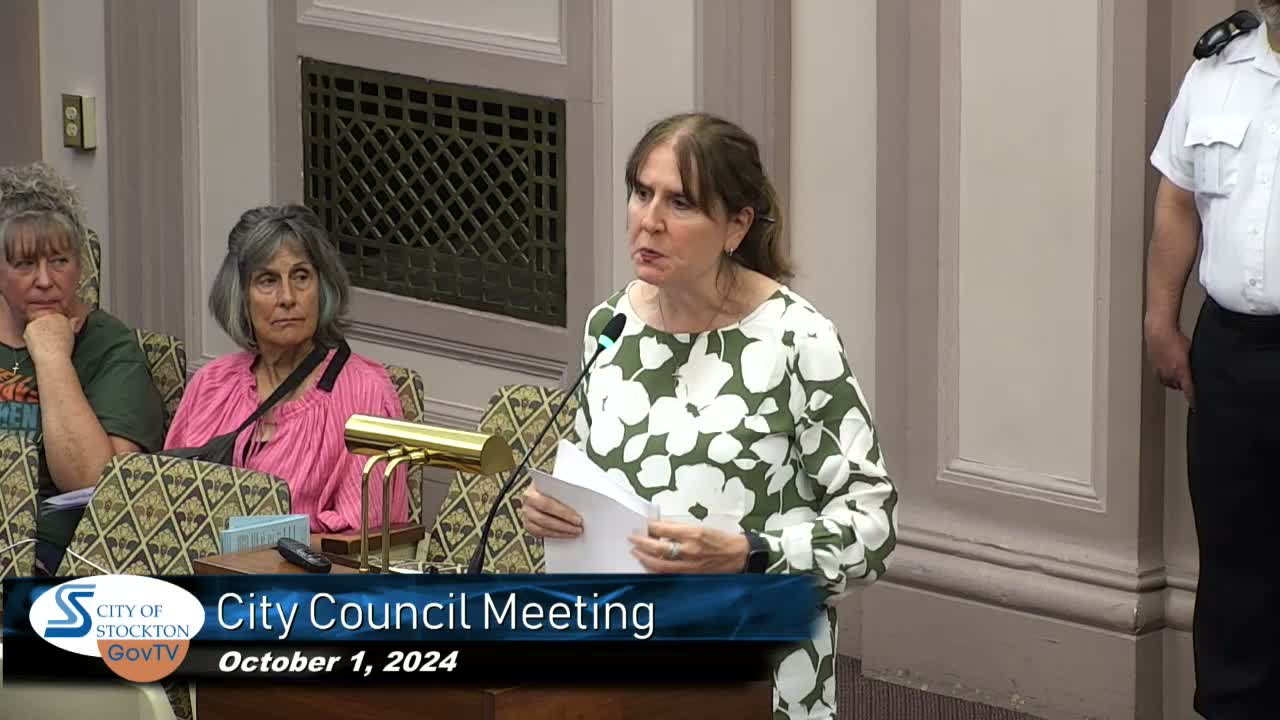
Community Medical Centers outlines mobile response, respite results as Stockton expands opioid-funded services
Summary
Community Medical Centers presented data Oct. 1 showing 9,905 MCRT calls since May 2023 and a busy summer with 604 initial calls and 1,476 follow-ups June–Aug 2024; presenters described case studies, police referrals, and the 24/7 respite center’s short-term recovery beds.
Community Medical Centers (CMC) updated the Stockton City Council on two city-supported programs funded in part by opioid-settlement dollars: the Mobile Community Response Team (MCRT) and the CMC Respite Center.
Lindsay Lopez, MCRT presenter, said the program has handled 9,905 calls from May 2023 through August 2024. For June–August 2024 the team recorded 604 initial calls and 1,476 follow-up calls; roughly 76 percent of summer calls were welfare or wellness checks, Lopez said.
Lopez highlighted a rise in police referrals: about 28 percent of recent calls came from law enforcement, up from roughly 6 percent reported previously, which she attributed to targeted outreach and rapport-building with specific officers. She said the MCRT operates daily from 8 a.m. to 11 p.m. and uses phone de-escalation where appropriate; the program logged 98 in-person mobile-team responses with ZIP-code reporting showing service across Stockton.
Tori Piasecki, a licensed clinical social worker on the team, described two case studies. One involved a person displaced from a trailer who had 37 dogs removed; MCRT coordinated among sheriff’s deputies, animal control and shelter partners to support the resident. Another case involved linkage to substance-use disorder treatment and rapid follow-up that resulted in clinical interventions and shelter or transportation support.
Lay McMiller and other CMC staff reviewed the Respite Center on Stanislaus Street, a 24/7 short-term facility with dormitory-style beds (eight for men, five for women) that provides monitored detox, SUD counseling, life-skills programming and 30-day aftercare follow-up. CMC reported 358 bed uses from June–August 2024 and cited individual success stories of clients who obtained employment and months of sobriety after completing the program.
Council members commended the program’s scaling and urged staff to document how the model can be sustained and replicated; the item was informational and required no council action.