Get Full Government Meeting Transcripts, Videos, & Alerts Forever!
Get email alerts on the Public Health topic
No spam. Unsubscribe anytime.
Stockton council advances revised tobacco retail rules; smoking‑lounge language sent back for more review
Summary
Staff proposed an urgent rewrite of Stockton's tobacco retail licensing to tighten inspections, add retailer classes and increase penalties; public health groups urged keeping a 1,000‑foot buffer and banning flavored tobacco and smoking lounges. Council accepted minor edits and voted 6‑0 to return lounge language to committee for more work.
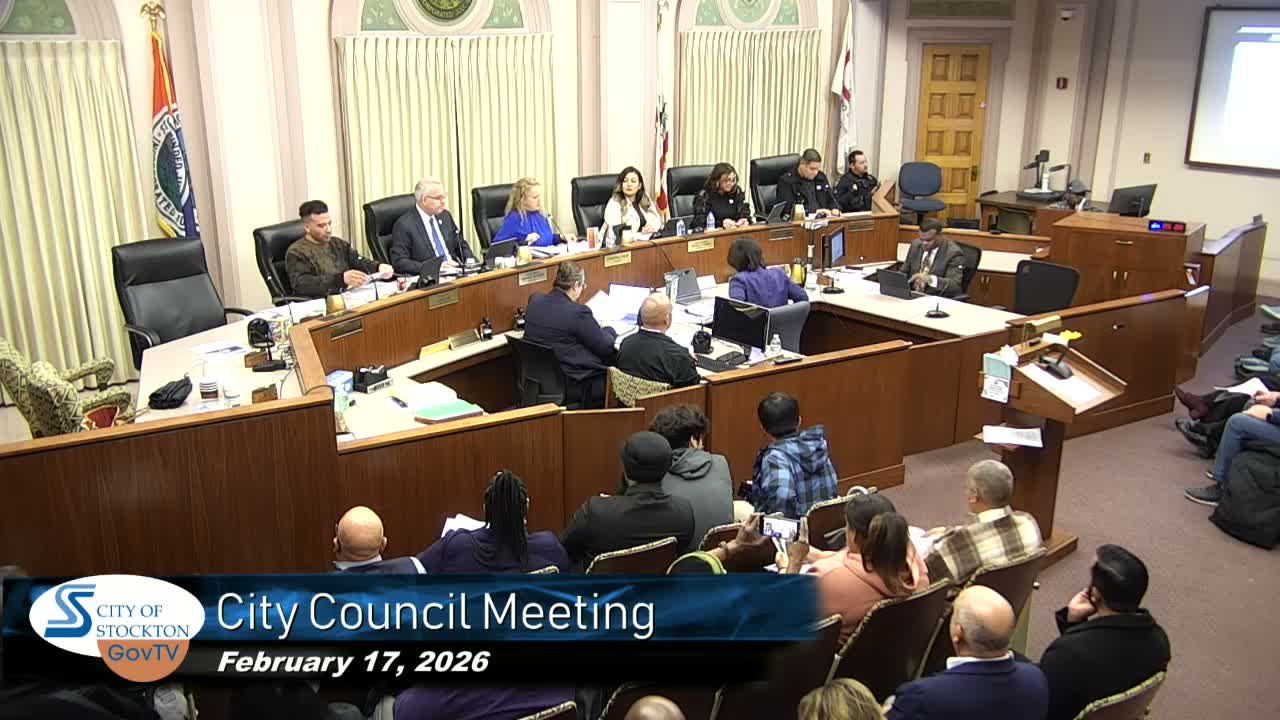
Stockton City Council on Feb. 17 heard a staff presentation on an urgency ordinance to amend Stockton Municipal Code Chapter 5.104 that would tighten the city’s tobacco retail licensing (TRL) rules, add four retailer categories and strengthen enforcement tools.
The proposed changes would require all retailers to apply for a TRL and submit detailed floor plans showing where tobacco would be sold or stored, require smoke‑shop applicants to file an annual security plan and allow police unannounced inspections. The draft also creates explicit penalties and a graduated suspension structure—30 days for a first qualifying violation, 60 for a second and revocation on a third, staff said.
“Sales to minors, selling flavored tobacco and knowingly concealing illegal product with intent to evade compliance—those are grounds for suspension and revocation,” said Captain Swain of the Stockton Police Department, who described enforcement tools including seizure and destruction of illegal product and cost recovery for reinspections.
Public health advocates warned council that the draft would weaken earlier protections. Twila Laster, project director for Saving Our Legacy: African Americans for Smoke‑Free Safe Places, said research shows retailer concentration increases exposure and normalizes smoking among young people and recommended retaining a uniform 1,000‑foot buffer from schools and youth‑serving sites.
“Creating multiple retailer classifications and adding exemptions could have adverse effects and ultimately increase the number of tobacco licenses,” Laster said.
Council members pressed staff on grandfathering, whether licenses could be transferred on sale, and on the effect of distance restrictions. City attorneys explained that exempt and ancillary categories (grocery and convenience store types) would not be subject to the same distance rules, while smoke shops and lounges would.
Councilmembers also debated whether to allow smoking lounges—hookah, cigar or similar venues—with some members saying the draft as written opened a carve‑out that could undermine prior bans on flavored tobacco. Several members urged the council to preserve reductions in retailer density achieved under the moratorium.
After debate, the council approved a motion 6‑0 to adopt the staff’s minor edits and direct staff to return smoking‑lounge language to the legislative committee (Lehi) for further review and potential tighter language. The council indicated it would retain the option to remove smoking lounges entirely in future revisions.
Council also asked staff to clarify enforcement resources, public complaint processes and the precise definitions used to classify retailers.
The urgency ordinance will be revised per council direction and brought back to the council and the legislative committee for additional drafting and public review before final adoption.