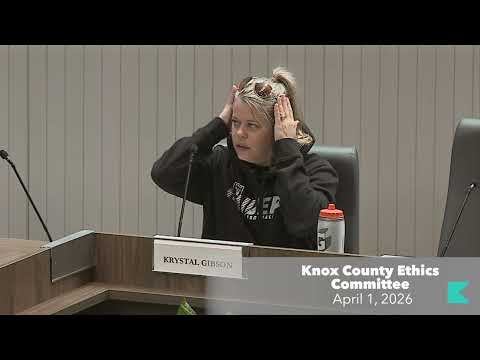
Knox County ethics committee debates lobbying ban, disclosure rules and nepotism language
Loading...
Summary
The Knox County Ethics Committee reviewed proposed revisions to the county code of ethics April 1, debating the length of a post-office lobbying prohibition, whether disclosure forms should be read into meeting records or filed with personnel/county clerk, and whether 'personal interest' should include nepotism; members agreed to seek legal guidance before finalizing changes.
The Knox County Ethics Committee on April 1 reviewed an extensive draft of the county code of ethics and deferred final decisions after members asked the law department to examine legal constraints on extending a post-office lobbying prohibition and on filing and disclosure procedures.
Committee members spent the largest portion of the meeting debating three matters: whether former elected officials should be barred from representing private clients before their former governing body for one or two years; how completed disclosure forms (Attachment A) should be stored and whether they should be read into the committee record; and whether the definition of "personal interest" — currently framed around financial interests — should be expanded to include nepotism or other relational conflicts.
"A person who's been elected to any county office may not personally represent another person or entity for compensation before the governing body of which that person was an officer for a period of one year after vacating that office," Kennedy read from the draft, prompting debate about aligning the provision with the National Association of Counties' recommendation for a two-year hiatus. Miss Gibson said the NACo proposal should be researched before a change is adopted: "We would change it from 1 year to 2 years so that aligned with those recommendations." Members agreed to ask the law department to review whether a two-year restriction would be legally permissible.
Members also addressed where disclosure forms should be kept and whether the chair should read completed attachments into the public meeting record. Chair Debbie Stafford raised confidentiality concerns and asked whether filings meant for personnel files should instead be broadcast at a public meeting: "If I'm in a department and I have a conflict of interest and I want to file this just to be on file in my personnel file, would it have to be read at the ethics committee meeting as part of public record?" Several members suggested that forms intended as personnel documentation could remain in employee files unless a formal complaint is filed.
On the definition of "personal interest," Stafford and other members urged broader language to capture nepotism and certain relational conflicts, not just financial ties: "Personal interest shouldn't be just financial," she said. Other members cautioned that state law and the practical limits of enforcement historically have focused ethics codes on financial conflicts, and that personnel or employment matters may fall under separate legal or HR policies. Quoting Tennessee statute language, a committee member summarized that ethical standards "do not include personnel or employment policies or procedures related to the operational aspects of governmental entities," and urged care to avoid drafting requirements that conflict with state law or existing county rules.
The committee approved routine business during the meeting: Miss Gibson moved to approve the March minutes; Goodpastor seconded and the motion passed on voice vote. Later, Kennnedy asked to reopen policy discussion by motion; the motion to reopen carried with committee members reporting "three 'ayes' and no nays."
No final code changes were adopted at the April 1 meeting. Members assigned follow-up tasks: the law department (via Mister Sanders) will research legal limits on extending the post-office lobbying ban and on filing requirements; Miss Gibson will research NACo's recommended standard; and the committee will revisit language on nepotism and attachment handling at a future meeting. The committee adjourned after the wrap-up.