Get Full Government Meeting Transcripts, Videos, & Alerts Forever!
Get email alerts on the Land Use topic
No spam. Unsubscribe anytime.
Commissioners debate growth‑management ordinance as council schedules first reading tonight
Summary
Hal Bailey presented a Preservation and Growth Management ordinance that would formalize a data-driven review of vacant land and urban service‑area expansion; commissioners raised concerns about a five‑year dwelling‑units‑per‑acre formula, commercial‑zone counting and assumptions; first reading was scheduled at the Urban County Council that evening with a second reading Feb. 12.
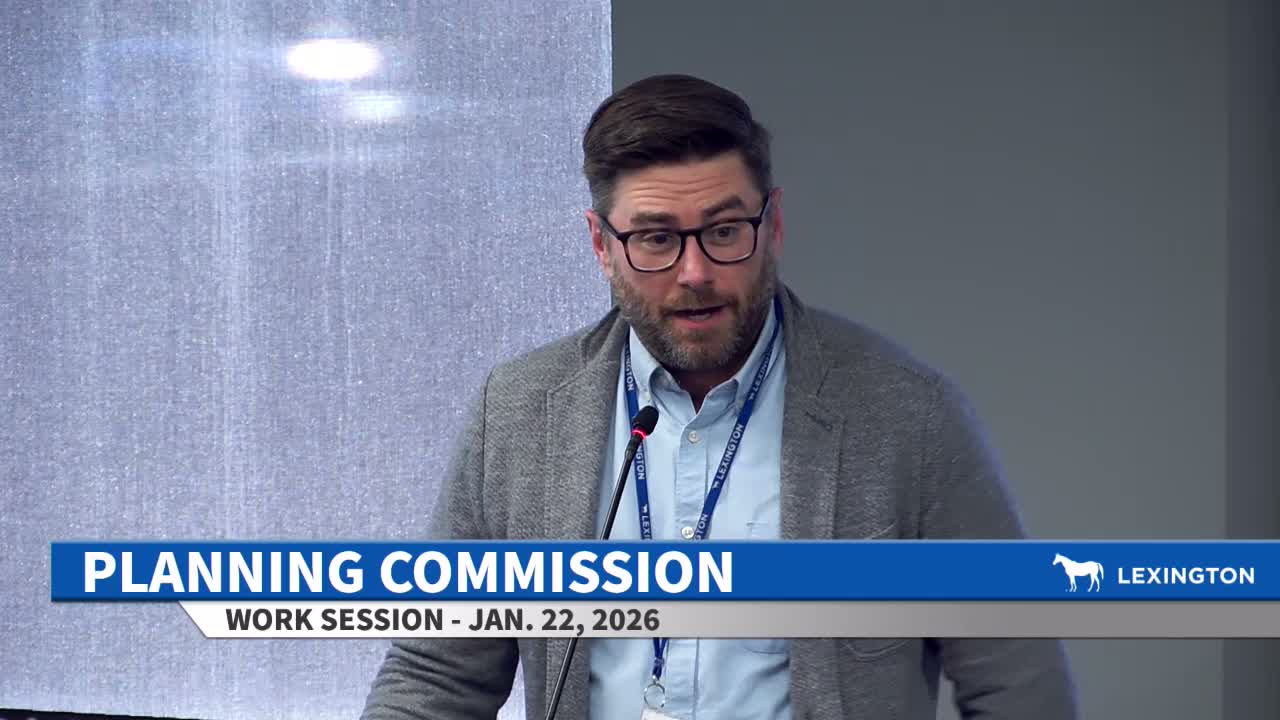
Hal (Mr. Bailey) presented the Lexington Preservation and Growth Management Program (LP GMP) proposal to the planning commission on Jan. 22, describing it as a process to separate urban‑service‑area expansion decisions from the comprehensive plan and to anchor reviews in data produced by the ImagineLexington Analytic Research Center.
Bailey said the ordinance is written to sit in the city's code of ordinances, to require a growth trends report and give decision‑makers a structured five‑year review cycle. He said the Urban County Council would hold a first reading that evening and a second reading on Feb. 12 before the planning commission would review a finalized draft at a February work session and hold a public hearing in March.
"This allows for us to focus in on all those very necessary action items, goals, objectives and policies that are necessary to achieve the community that has been called for in the public input for the comprehensive plan," Bailey said, describing how the ordinance would set criteria for vacant‑land review, subcommittee composition and, in some cases, require a supermajority of council to move expansions forward.
Commissioners raised several substantive concerns during discussion. Commissioner Mickleth argued the ordinance's projection method — using a five‑year average dwelling‑units‑per‑acre to calculate land need — risks undercounting longer‑term growth spikes and excludes dense downtown or commercial infill projects from the formula in ways that could skew results.
"You wouldn't necessarily want to take your 5‑year previous average and say, yes, we're expecting 100,000 people here," Mickleth said, urging that projections tied to comprehensive‑plan goals or intended densities be considered instead of a short moving average.
Staff defended the approach as intentionally assumption‑light: the formula is meant to produce a replicable baseline without policy assumptions baked into the calculation, while the growth trends report and future iterations would be the venue for policy recommendations and scenario analysis. Staff also said they will report residential units in commercial and mixed‑use zones in the growth trends report even if those units are excluded from the 5‑year dwelling‑units formula.
Other commissioners asked how student populations (University of Kentucky) are counted; Bailey said the U.S. Census Bureau rules apply (group‑quarters counts are treated separately). Questions about soil conservation language and government‑owned property were addressed: staff said language was added to prompt subcommittee review and noted sovereign immunity limits how government‑owned sites are classified.
Bailey said the ordinance incorporates long‑standing vacant‑land review practices and would allow the council and planning commission to recommend policy or regulatory changes based on the growth trends data. He urged that the approach provide breathing room after the recent expansion so the city can build robust data and revisit assumptions before moving land into the urban service area.
No formal action or vote on the ordinance occurred during the work session; staff said the item would advance to council for scheduled readings and return for planning commission hearings and a public comment period.