Get Full Government Meeting Transcripts, Videos, & Alerts Forever!
Get email alerts on the Land Use topic
No spam. Unsubscribe anytime.
Raymore council adopts anti‑monotony housing standards after debate over landscaping rules
Summary
The Raymore City Council approved the 38th amendment to the Unified Development Code to require more variety in lot widths, front elevations and landscaping points for new single‑ and two‑family developments; council members debated whether landscaping maintenance would create long‑term burdens for homeowners before the measure passed 6–2.
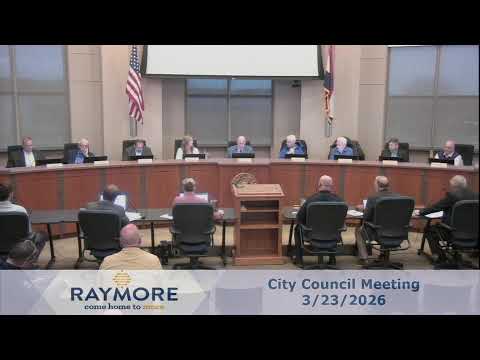
The Raymore City Council voted 6–2 on March 23 to approve an amendment to the Unified Development Code that establishes residential design standards intended to reduce monotony in new subdivisions.
Staff presented the proposal as a multi‑phase approach: require greater diversity in lot widths at subdivision platting, require more variety in front‑elevation entry features (porches, patios, courtyards) during construction, and raise landscaping point requirements for new projects to improve street‑level curb appeal. Planning and Zoning unanimously recommended approval, and staff said the change is not intended to regulate home types, minimum footprint sizes or price points.
During the public hearing Jamie Faulconer of Outdoor Solutions, who identified himself as the landscaper who suggested the point‑system change to staff, urged caution about added costs. “I would be careful about the added cost that this does drive into homes,” Faulconer said, warning the standards could raise prices for entry‑level buyers and create maintenance challenges in age‑restricted or low‑maintenance communities.
Councilmember Baker pressed staff on whether the ordinance would impose a continuing maintenance obligation on homeowners. Planning staff (Mister Gress) and city legal counsel clarified the code section Baker referenced applies to site plans for commercial developments and does not create an ongoing maintenance obligation for typical single‑family residential lots after a certificate of occupancy. “To answer your question…that same maintenance requirement does not apply to residential construction,” staff said, describing the inspection process as a one‑time verification that point values were met prior to certificate issuance.
Several councilmembers said they supported the anti‑monotony goals but asked for more flexibility on landscaping for certain neighborhoods and for senior developments, noting homeowners’ preferences and long‑term maintenance costs. Councilmember Mills asked for additional review of the landscaping provisions; Mills said he favored the overall package but would like “a little bit more flexibility” on landscaping options.
Despite those concerns, the council moved to approve the ordinance on its first reading. The amendment carries new landscape point valuations (for example, the code now gives three points for a 3‑gallon shrub and one point for a 1‑gallon shrub, to better reflect coverage and encourage higher‑value plantings) and requires staff verification during the building process that landscaping meets the required points. The measure does allow exemptions or alternative approaches through established zoning approval processes such as PUDs or overlay districts, where a developer could propose different low‑maintenance amenities in exchange for relief from specific requirements.
The council ended the discussion by voting 6 in favor and 2 opposed to advance the amendment.