Children's Services seeks millions to cover high‑acuity placements as overall custody declines
Loading...
Summary
Department of Children's Services told the Senate Finance Committee that while the total number of children in custody has fallen, the state faces growing demand for high‑acuity residential placements and is requesting increased funding for residential custodial care and expanded private provider case management.
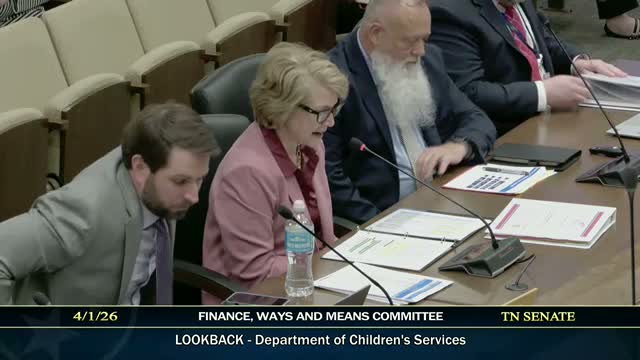
Department of Children's Services Commissioner Margie Quinn presented the agency's FY27 budget request to the Senate Finance, Ways and Means Committee, framing the request around two main drivers: the rising number of children who require high‑acuity residential placements and the need to expand private provider case management capacity.
Quinn said the department's proposed increases include roughly $36.8 million to address residential custodial needs (children with complex behavioral, medical or mental‑health requirements) and $34.5 million to expand private provider case management capacity, the latter designed to lower caseloads for state case managers and comply with statutory case‑load expectations. DCS highlighted that although overall custody counts decreased by about 5% from 2022 to 2026, the population now in care requires more intensive and costly services — some placements can cost hundreds of dollars per day compared with the $37/day foster board rate for traditional foster homes.
Commissioner Quinn and the agency's network director described efforts to expand therapeutic foster care, increase in‑state capacity and reduce reliance on out‑of‑state residential placements (DCS reported out‑of‑state placements fell to 79 from over 200 a year earlier). Committee members sought clarity on utilization rates for foster homes, wait lists for the relative caregiver program and whether private case management funding would change internal workforce classifications; DCS said some existing positions would be reclassified and staff moved to CPS duties as part of implementation.
Quinn also outlined capital plans from earlier appropriations: two juvenile justice campuses and six regional welcome/wellness assessment centers (one in each region) are planned, with ground‑breaking anticipated in 2026–27 for several sites and phased construction timelines. The department said it expects some centers to be third‑party operated and emphasized provider recruitment for therapeutic foster placements.
Committee members pressed DCS on difficult operational questions — for example, when bench orders place youth adjudicated delinquent into DCS custody as dependent neglect, DCS said statutory constraints limit options and the department has proposed legislative fixes to reduce commingling of violent/delinquent youth with other children in care.
What happens next: DCS will provide more granular breakdowns of provider contract costs and utilization data; committee members indicated they will monitor implementation measures and utilization metrics if the recurring funding is approved.
Representative quotes below are taken from committee testimony and were attributed only to speakers who either self‑identified or were introduced on the record.