Lifetime Citizen Portal Access — AI Briefings, Alerts & Unlimited Follows
Planning board recommends approval of general rezoning for 121 Gilead Road after debate over historic protections
Loading...
Summary
After extended debate about historic preservation and the limits of general rezoning, the Huntersville Planning Board voted 5'to'2 to recommend changing 121 Gilead Road from Neighborhood Residential to Town Center, a non'conditional rezoning that would permit by'right uses allowed in the town center district.
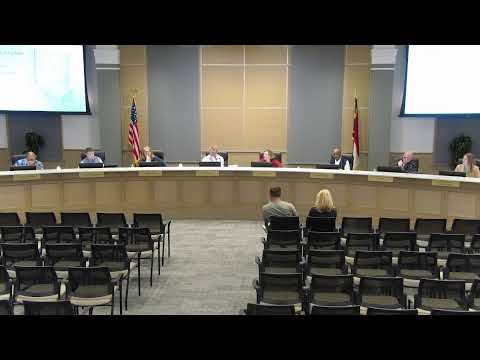
The Huntersville Planning Board recommended approval 5'to'2 on March 24 for petition R26'02, which seeks to change 121 Gilead Road from Neighborhood Residential (NR) to Town Center (TC).
Staff opened the item by showing the parcel's location inside the town's mixed-use downtown area and told the board the rezoning is consistent with the Huntersville 2040 community plan and the 2022 downtown master plan. Staff emphasized this is a general rezoning, not a conditional rezoning, meaning the district change would allow all uses permitted by the TC district unless restricted through other regulations.
"If the rezoning is successful, anything under the town center's zoning designation as far as the use would be permitted," staff said, describing how the change aligns the site with long-range downtown policy.
Opponents on the board cautioned that a general rezoning removes an opportunity for the board to require site-specific conditions or design commitments. "We're giving up leverage," one committee member said, arguing the town would lose a key review step that can secure higher design standards and mitigate spillover impacts on adjacent residences.
Applicant Brian Hines of HFH Investments, who said the house is designated historic by the Charlotte'Mecklenburg Landmarks Commission, told the board he bought the property in 2020 and currently uses it for offices. "We have no intention of unwinding historical designation," Hines said, and added that the ownership group would not entertain a nightclub and sees likely future uses such as a restaurant. He described the designation as limited to the exterior, the stairwell and interior hallways and said tearing the building down would require a county and town review.
Board members pressed whether a future owner could remove protections and what rights the town would forfeit under a general rezoning. Staff answered that demolition or other substantive changes would require approvals and that other town requirements'such as parking, tree-save rules and noise ordinances'could limit bulk redevelopment, but they also acknowledged a general rezoning eliminates the conditional rezoning process where the board can negotiate specific conditions.
After discussion and a failed motion to recommend denial, the board voted 5'to'2 to recommend approval of R26'02. The planning board's recommendation is advisory and will be forwarded to the town board for final action.
The next procedural step is review by the Town Board; the transcript did not specify a Town Board hearing date.