Budget and Taxation Committee moves bill to reshape Baltimore-area transit oversight, exempt some MTA projects from procurement rules
Loading...
Summary
The Budget and Taxation Committee moved Senate Bill 9 47 favorable after debating creation of two oversight boards for Baltimore-area core transit and commuter services, concerns over gubernatorial appointments and geographic representation, and fiscal effects from removing a $400,000 tort cap.
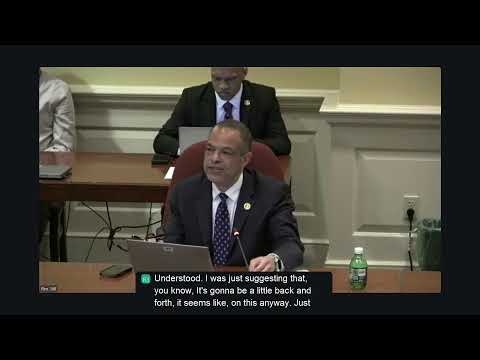
The Budget and Taxation Committee advanced Senate Bill 9 47 after members debated how the measure would reshape oversight of transit in the Baltimore region and affect Maryland Transit Administration (MTA) projects.
A staff member presenting the bill told the committee it “exempts certain MTA projects from state procurement law, requires the Maryland transit transportation commission to make qualification and compensation determination for certain MTA employees, and repeals the Baltimore transit regional commission established in 2023,” replacing it with two oversight boards: one for core Baltimore-area services and one for commuter service.
Committee members pressed staff on how the commuter board would treat MARC commuter rail. A committee member explained that the bill defines “commuter service” to include MARC and the administration’s commuter bus service and that the commuter advisory board would cover those functions statewide. Members expressed concern that, as written, the governor could appoint all six board members from a single county because the bill specifies that board members must “reside in areas served by MARC or administration commuter buses” without explicit geographic-distribution language.
The committee also discussed a fiscal consequence of the bill: removing a $400,000 tort cap from current law. The staff presenter said taking out the cap would increase the fiscal impact but that “there are too many unknowns,” including costs tied to board membership and litigation exposure. Members noted the issue is contentious in Finance and said they expected additional negotiation between the chambers; the House version, they said, retained eminent-domain language and in some respects retained the tort cap.
After discussion, a motion to move the bill favorable was made and the committee took a voice vote; the clerk reported ten members present with one absence and the chair announced the motion moved favorable with one opposed.
The bill is secondary in this committee; committee members noted the primary committee is Finance and signaled further deliberations will occur there.