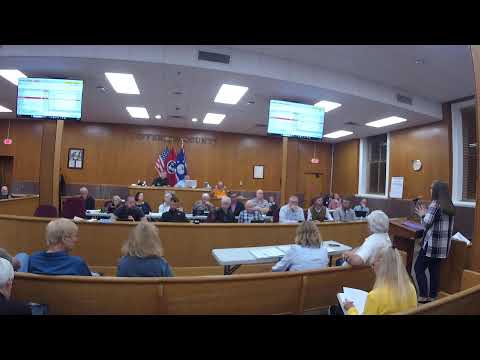
Jefferson County commissioners reject proposed 20¢ mineral severance tax after hours of testimony
Loading...
Summary
After more than two hours of public comment and a county presentation estimating $13.6 million over 20 years for roads, the Jefferson County Board of Commissioners voted 12-5 to reject a proposed 20¢ per‑ton mineral severance tax that would have funded county road repairs.
The Jefferson County Board of Commissioners voted 12-5 on March 16 to reject Resolution 20 26-11, a proposal to levy a 20¢ per‑ton mineral severance tax on sand, gravel, sandstone, chert and limestone to fund county paved roads.
Supporters of the tax argued it would generate a dedicated revenue stream for roads and reduce pressure on property taxpayers. During a county presentation, staff estimated the levy could yield roughly $518,000 over the first five years and $13.6 million over 20 years based on reported annual tonnage; the presenter noted the authority for the tax has been in Tennessee law since 1985 and said revenue must be dedicated to county paved-road funds.
Opponents — led in testimony by miners, trucking companies and several mine employees — warned the tax would imperil local jobs and a pending smelter investment. "A small tax increase on paper can turn into a very big loss in reality," said Chuck Lane, who identified himself as president of the Tennessee Mining Association. Several mine employees described thin margins and said increased costs would be passed down to workers or local businesses. "If they say I'm not making anything off this, it usually shuts down," said Austin Lawson, who told the commission he worked for Nearstar.
County staff and some commissioners pushed back on job‑loss claims but also raised technical concerns about relying on mineral tax receipts as a stable replacement for property tax revenue. Commissioner Katie Helfacker said she was concerned that shifting local maintenance funding to volatile, self‑reported mineral revenues could jeopardize the county’s maintenance‑of‑effort calculation and reduce state aid. The county presentation acknowledged variability and noted that certain mined products used in agriculture are exempt from the tax.
Nearstar representatives told the commission the operation was not currently cash‑positive and that further tax pressure could affect employment and a pending sale. "From a net revenue perspective, I do believe that the numbers are currently overstated," said Matthew Harding, who introduced himself as vice president of operations for Nearstar Tennessee; he said the company was forecasting marginal earnings and rising operational pressures.
Commission debate focused on weighing a long‑standing local need for road funding against potential economic risk to a major local employer. After motions and a roll call, the measure failed 12‑5. The commission moved on to other agenda items, including a grant application for recreational trails that passed unanimously.
The next procedural step for the mineral‑tax question is unclear; commissioners did not schedule a follow‑up vote at the meeting.