Johnston County officials outline draft Unified Development Ordinance, say zoning map won’t change
Loading...
Summary
County planning staff presented a draft Unified Development Ordinance that updates development standards, creates optional 'paper' zoning districts and standardizes agricultural buffers; officials said the draft preserves bona fide farm protections and will not remap property automatically.
Johnston County officials on Monday laid out a proposed Unified Development Ordinance (UDO), explaining how the rewrite would update development standards, create optional "paper" zoning districts and standardize compatibility buffers while keeping statutory farm protections in place. No votes were taken; the session was an informational meeting and staff will post a revised draft after collecting feedback.
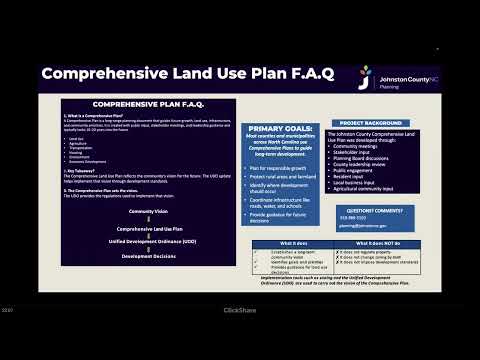
Braston Newton, the county planning director, told attendees the UDO is intended to implement the county’s 2040 comprehensive plan and to clarify long-standing, scattered land-development rules. "This zoning map is not changing as part [of adoption]," Newton said. "What you're zoned today is what you will be zoned tomorrow." He said the update focuses on rules and standards — for lot size, building height, site design and signage — rather than automatic remapping of property.
Consultant Anna Willis walked through the proposed "paper districts" that would be added to the code and available through rezoning applications: an Agricultural district (proposed at 1 unit per 5 acres), Agricultural Estate (1 unit per 2 acres), Estate Residential (1 unit per acre), Residential Neighborhood (about 4 units per acre, up to 5 with conservation subdivisions) and Traditional Neighborhood (4 detached or 6 attached units per acre, with conservation options up to 8). Willis explained gross vs. net density and the rezoning process, which would require public hearings and property-owner actions before any parcel is mapped to a new district.
Newton and Willis emphasized the draft’s alignment with North Carolina statutory requirements. Newton cited the state statute that protects bona fide farms and described the documentation that can establish farm status (examples he mentioned include a farm sales tax exemption certificate, inclusion in present-use tax programs, Schedule A on tax returns or a forest-management plan). Willis added that the version 3 draft had not been posted yet and that staff would consider edits after collecting tonight’s feedback.
On buffers, Newton said staff had proposed standardizing the agricultural compatibility buffer at 35 feet and placing responsibility for landscaping/vegetation inside the buffer primarily on the proposed development rather than the farm. He said those numbers reflect negotiation among stakeholders and remain subject to change based on further input. Newton also noted a recent state legislative limit: local governments cannot downzone private property without each owner’s written consent, which is why the county used paper districts rather than remapping parcels automatically.
Officials repeatedly reassured residents that limits on farm animals would not be included in the next draft. "The next UDO draft will not include farm animals," the chair and staff said in response to repeated public questions about chickens, roosters and small hobby livestock.
The county encouraged residents to visit informational stations in the back of the room, place feedback dots on buffer options and leave written comments. Staff said they will post an updated draft and continue public engagement before any decision by the Board of County Commissioners.
The meeting closed with staff directing attendees to breakout stations for detailed one-on-one discussion; commissioners said the county will continue to revise the draft based on community input.