Get Full Government Meeting Transcripts, Videos, & Alerts Forever!
Get email alerts on the Training Ethics Zoning topic
No spam. Unsubscribe anytime.
City attorney’s annual training stresses open-meetings rules, variances and a new 'special exception' process
Summary
City Attorney Joshua Whitehead gave annual ethics and zoning training at the Jan. 13 Germantown BZA meeting, reviewing open‑meetings law, limits on ex parte contacts, variance standards and a pending zoning text amendment that would route some 'uses on appeal' to the planning commission and add a 'special exception' process for accessory structures.
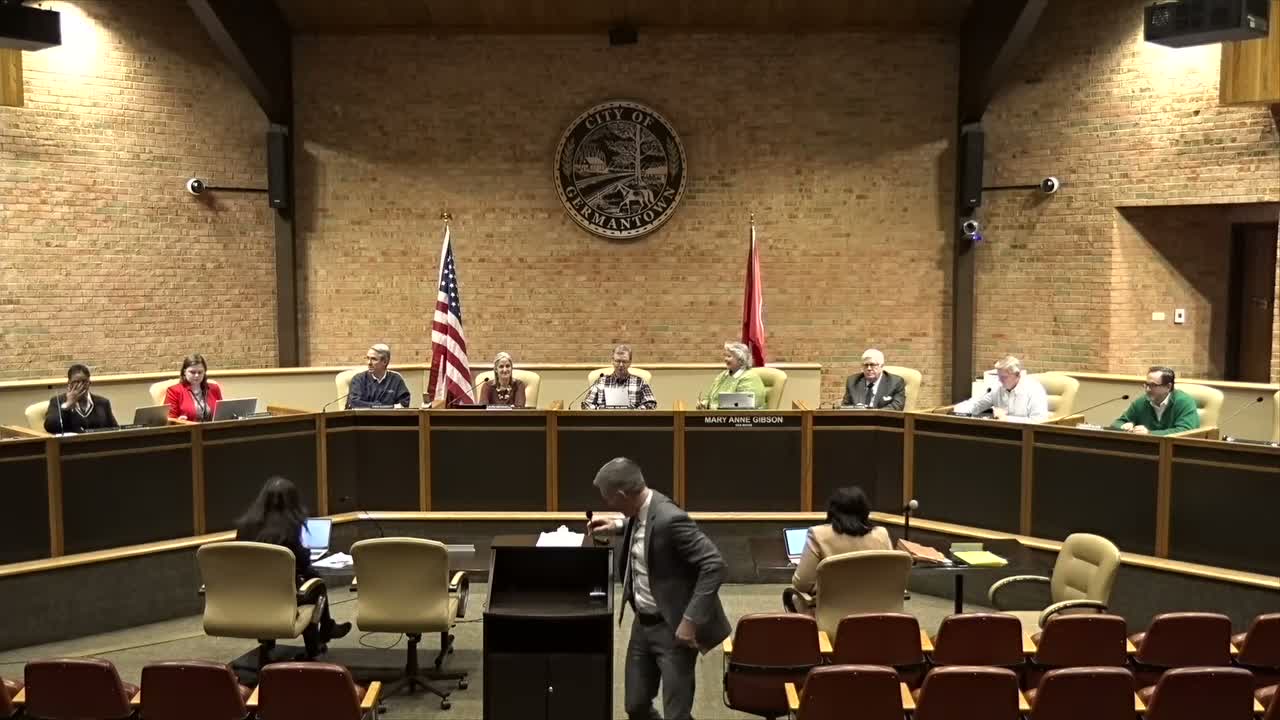
Joshua Whitehead, identified in the meeting as city attorney, led the Board of Zoning Appeals through annual ethics and zoning training at the Jan. 13 meeting, emphasizing courtroom‑style duties, strict open‑meetings rules and recent proposed changes to the city’s zoning procedures.
Whitehead opened by reminding members that the BZA is a “quasi‑judicial body” and urged that deliberations occur on the record. “When you’re deposed on a case that goes south and gets litigated, you can say … everything I did was on the record,” he said, adding that maintaining documented justifications speeds litigation and reduces taxpayer expense.
On open meetings and ex parte communications, Whitehead warned members to avoid private deliberations about cases and suggested, if off‑the‑record conversations do occur, that members make themselves available to both sides to reduce impartiality concerns.
Whitehead devoted substantial time to variances, calling them “your main thing” for the BZA and outlining statutory standards members must apply — exceptional shape, shallowness, topographic conditions or other extraordinary circumstances that create a practical difficulty or undue hardship. He cautioned that financial disadvantage alone is not sufficient to prove hardship but often appears alongside other factors.
He described a pending zoning text amendment that will move many “uses on appeal” (for example, churches, schools and government buildings) to a conditional‑use permit process under the planning commission. To fill the BZA’s resulting jurisdictional gap, the city proposes a special‑exception process limited initially to accessory‑structure sizing. Whitehead summarized the lower threshold for special exceptions: the request must not “impart a substantial or undue adverse effect upon adjacent property owners,” must be compatible with the immediate vicinity and must be served adequately by essential public facilities.
On ethics, Whitehead restated the code of conduct: officers must not use their positions for personal financial gain and should not vote on matters where they or family have a financial interest. He explained recusal procedures and practical steps for preserving a quorum, including abstaining from votes when necessary rather than deferring matters repeatedly.
Board members asked questions about standards and procedures; Whitehead reiterated that staff will provide the specific conditions and criteria for special exceptions when such cases arise. The board then moved to accept the annual training; the item was taken as presented and no formal roll‑call vote was recorded.
Whitehead’s training covered legal and procedural practices the BZA will rely on as the city rolls out the zoning text amendment and as the board continues to hear variance requests.