Get Full Government Meeting Transcripts, Videos, & Alerts Forever!
Get email alerts on the Surveillance Policy topic
No spam. Unsubscribe anytime.
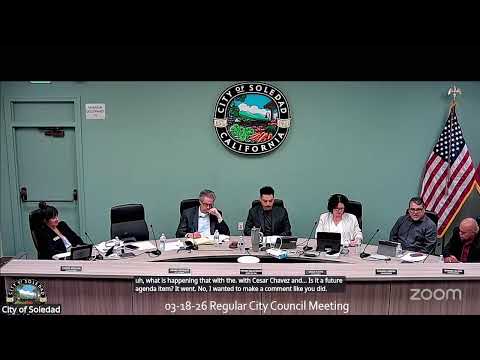
Soledad council adopts clearer limits on license-plate data sharing, bars use for immigration enforcement
Summary
The Soledad City Council adopted changes to Police Department policy 4.70 to add explicit prohibitions on sharing automated license-plate reader (ALPR) data for immigration enforcement and to require chief-level review before any data release, after council debate about privacy, vendor controls and oversight.
The Soledad City Council on Tuesday accepted amendments to Police Department policy 4.70 that add local safeguards for automated license-plate reader (ALPR) data, including an explicit statement that ALPR information will not be shared for immigration enforcement purposes.
Lieutenant Areola and Chief Patrick Valenzuela told the council the department's ALPR system, operated through vendor Flock Safety and governed by a Lexipol-based policy, has helped investigations into stolen and missing vehicles. Following reports of improper access elsewhere in California, staff reviewed comparable city policies and recommended language modeled on the City of Salinas to remove ambiguity about data sharing.
"We reviewed the ALPR policies and regulatory controls used by a number of other California cities," Lieutenant Areola said, and noted that the Salinas language explicitly prohibits sharing ALPR information with entities for purposes barred by law, including U.S. Immigration and Customs Enforcement.
Council members pressed staff on whether outside agencies that receive shared data would be required to hold identical policies and how vendor settings or "unchecked boxes" might allow outside access. Chief Valenzuela and staff said Lexipol is widely used and that the Salinas-style additions provide a clearer layer of protection; they described audit controls and a requirement that the chief or designee confirm legal authority before releasing data.
"We have audits in place so that everybody knows what is going on with our system," a department representative said, adding that data requests from other agencies require justification such as a crime report number.
Several council members expressed support for stronger local policy language while debating whether to pursue a broader surveillance ordinance covering future technologies. The council adopted Resolution 63 44 accepting the proposed amendments by voice vote.
The policy changes are intended to clarify existing statutory limits under California law (SB 34) and to give the community greater assurance about how ALPR information will be shared and overseen. Staff said proposed camera expansions or equipment acquisitions would return to council for separate authorization.