Get Full Government Meeting Transcripts, Videos, & Alerts Forever!
Get email alerts on the Short Term Rental topic
No spam. Unsubscribe anytime.
Board deadlocks on Montero short‑term rental and variance; applicants may reapply sooner because vote tied
Summary
The board produced tie votes on both a variance request (to reduce the AG‑zone 1‑mile buffer to 450 feet) and the conditional‑use permit for an unhosted short‑term rental at 3512 Rosalie Road (PLNBOA25-143); because each motion resulted in a tie rather than a majority disapproval, the applicants are not barred by the usual one‑year waiting period from reapplying.
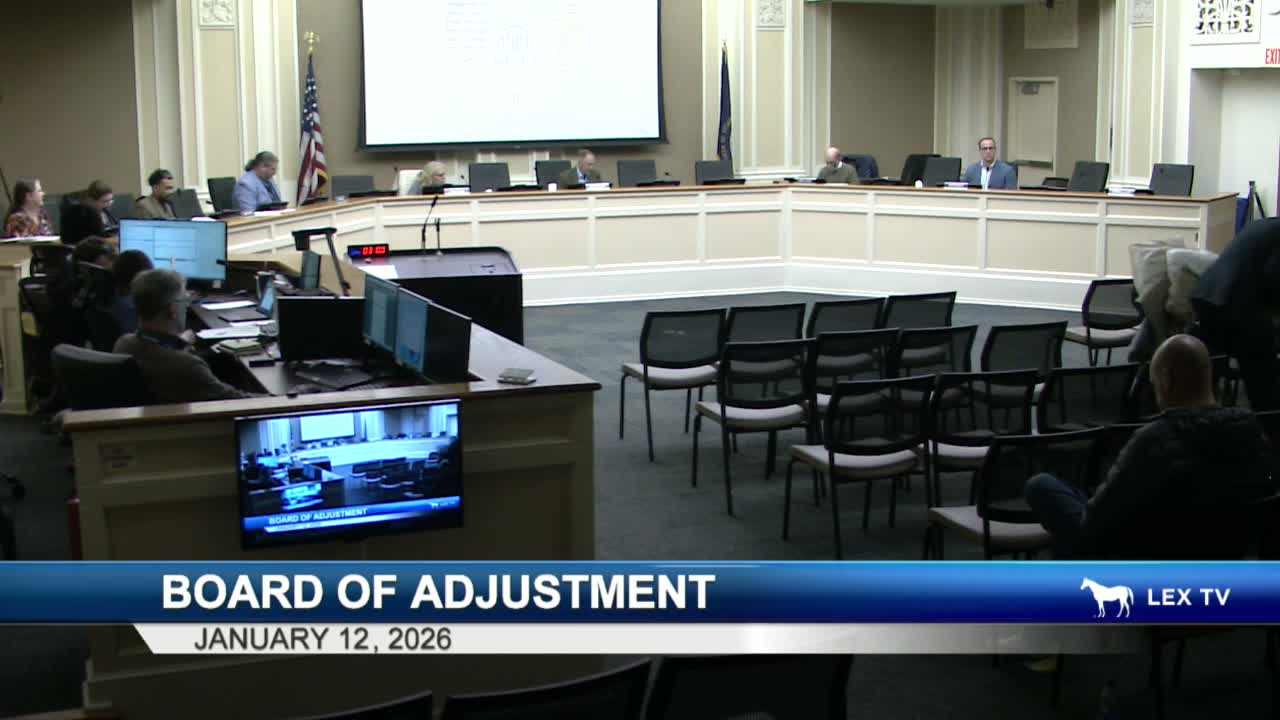
The Fayette County Board of Adjustment deadlocked on the Montero family’s application for a conditional‑use permit and a variance for an unhosted short‑term rental at 3512 Rosalie Road.
Planning staff recommended disapproval of both the variance (reducing the 1‑mile spacing requirement to 450 feet) and the CUP, citing Article 7 of the zoning ordinance and KRS 100.243 and noting two existing AG‑zone STRs within the one‑mile buffer. Applicant Sybil Montero said the family intends only seasonal, limited rentals (primarily April and October), would maintain the property, and already has a nearby property manager to serve as emergency contact.
Board members discussed whether adjacency to Keeneland and equine activity, the parcel configuration and the local context could provide extenuating circumstances similar to the Jolly Properties case; others pointed out the ordinance sets a strict 1‑mile buffer in agricultural zones and that the existing STR licenses still show up in revenue records.
A motion to grant the variance failed on a tie vote, meaning the variance was not adopted. Separately, the board took up the conditional‑use permit and made a motion to uphold staff’s disapproval; that motion also resulted in a tie, which again meant the permit was not approved. Because the outcome was a tie rather than a definitive majority disapproval, board staff advised that the applicants could reapply sooner than the standard one‑year waiting period that follows a majority denial.
The applicants were told they may consider alternative configurations (hosted/farm‑stay or other permit types) or seek additional evidence about nearby licenses; the board did not issue conditions or approvals at this meeting.