Get Full Government Meeting Transcripts, Videos, & Alerts Forever!
Get email alerts on the Short Term Rental topic
No spam. Unsubscribe anytime.
Board approves variance and conditional-use permit for historic Georgetown Road property despite staff opposition
Summary
After extensive testimony and a brief recess to draft findings, the Fayette County Board of Adjustment voted to grant a variance reducing the AG‑zone spacing requirement and to approve a conditional-use permit for an unhosted short‑term rental at 3501 Georgetown Road (PLNBOA25-133), citing the lot’s unusual shape, proximity to I‑75 and tourism uses.
The Fayette County Board of Adjustment approved a variance and conditional‑use permit for Jolly Properties at 3501 Georgetown Road on a motion that followed a lengthy staff presentation, applicant testimony and a five‑minute recess to draft findings.
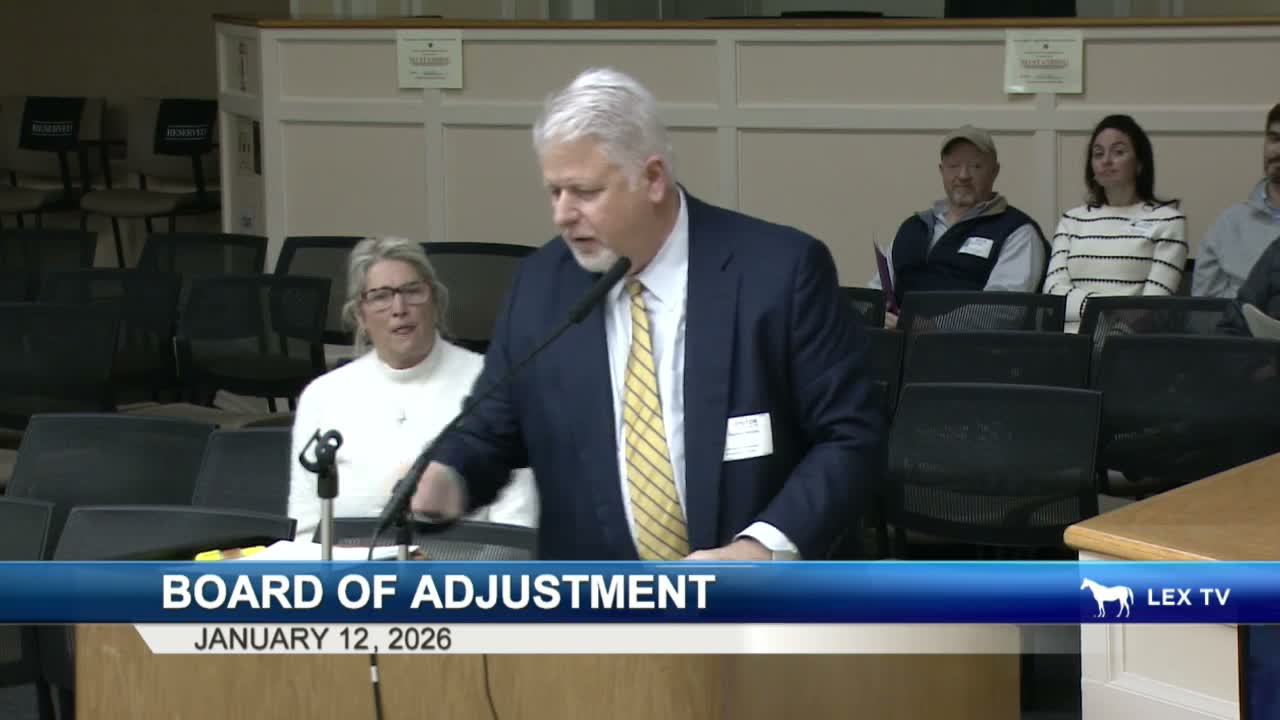
Steven Amato, attorney for the owner, told the board the property centers on a historic residence known as the TD Bassey House and that recent and planned roadway projects have left the parcel an unusually shaped remnant that is no longer practical for agricultural uses. “This property has unique circumstances — the shape of the lot, I‑75 right there, and the Georgetown Road improvements,” Amato said, arguing a short‑term rental will help preserve the house. Owner Barry Jolley described nearly $1.1 million invested in conservation and renovations.
Planning staff had recommended disapproval, saying the applicant did not meet the legal standard in Article 7 of the zoning ordinance or KRS 100.243 for a variance from the AG‑zone 1‑mile spacing requirement; staff also flagged potential access and traffic concerns. Staff emphasized that the AG zoning rules treat short‑term rentals differently than residential zones and that no relief provisions exist for this type of spacing requirement.
Board members pressed staff and the applicant on how distances were measured and on the likely impacts of planned Department of Transportation work that the applicant says will take part of the parcel. After the recess, board member(s) moved to find that the variance would not alter the character of the vicinity, that the lot’s oblong shape and bordering interstate made agricultural use impractical, and that the conditional‑use criteria were satisfied (adequate parking for eight vehicles, septic adequacy, and limited occupancy). The board voted to grant the variance (to 3,603 feet) and to approve the conditional‑use permit subject to conditions including occupancy limits and required permits.
The board’s approval overturns staff’s recommendation and allows the owner to operate an unhosted short‑term rental on the property. Steven Amato said the applicants accepted the conditions. The decision includes standard conditions requiring compliance with revenue, planning and health‑department approvals; the board also required documentation verifying septic capacity and set an occupancy cap consistent with staff’s typical conditions.
What happens next: the applicants may proceed with the licensing steps required by the Division of Revenue and the Division of Planning and Building Inspection. The board’s written findings will reflect the reasons cited at the meeting.