Lifetime Citizen Portal Access — AI Briefings, Alerts & Unlimited Follows
Subcommittee adopts DLS decision package with targeted reductions, reporting requirements and funding restrictions
Loading...
Summary
The Public Safety, Transportation, and Environment Subcommittee reviewed DLS recommendations across multiple agencies and, with modifications, adopted most items: substantive adjustments were made to judiciary funding, a $500,000 hold was placed on a Department of Natural Resources transfer item, funding conditions tied police enhancement funding to an assault‑kit notification protocol, and multiple agencies were ordered to submit reports. The panel will revisit decisions before the full committee later this week.
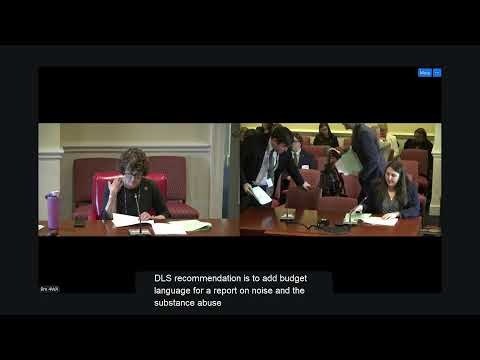
The Public Safety, Transportation, and Environment Subcommittee met for a decision‑report session and adopted a large portion of the Department of Legislative Services (DLS) decision document with a series of modifications, funding restrictions and reporting requirements.
Chair (speaker 1) opened the meeting by thanking DLS analysts for preparing materials covering 47 agencies. DLS staff then walked the panel through sections for the judiciary, legal agencies, transportation agencies, natural resources, public safety and others; members debated, modified and adopted recommendations by voice vote.
Most prominent among the fiscal adjustments, the subcommittee modified several DLS reductions for the judiciary: a proposed $2.5 million reduction tied to district court contractual employee salary increases was halved by the panel to $1.25 million and adopted; an IT reduction originally proposed at $7 million was reduced to $5 million; and the committee rejected a proposal to abolish three newly proposed positions. The panel also adopted committee narrative language on judicial compensation, problem‑solving courts, land records and other judicial program narratives.
The Office of the Public Defender faced several changes: the panel modified a turnover‑related reduction to $450,000 and adopted language restricting certain deficiency and panel attorney appropriations to be used only for panel attorney fees; the committee also adopted narratives addressing panel attorney caseloads and expenditures.
For the Governor's Office of Crime Prevention, the subcommittee declined to delete unmandated enhancement funding for state aid for police protection and adopted additional language requiring that enhancement funds be disbursed only after law enforcement agencies attest compliance with the Maryland assault‑kit initiative victim notification protocol (the transcript contains a redaction at the protocol name). The panel also rejected a DLS recommendation to delete a proposed violence reduction strategy grant and instead preserved the funding.
Transportation and infrastructure reviews produced a set of reporting requirements and technical amendments: MDOT and modal agencies were asked to provide notifications about capital program changes, reports on nontraditional debt, status updates for the Purple Line and Red Line projects, and a report on toll billing and collection issues tied to MDOT/MDTA. The Maryland Port Administration was asked to provide quarterly reporting on the Howard Street Tunnel project.
The Department of Natural Resources had $500,000 in funds restricted until the agency submitted a confirmatory letter on completion of the transfer relating to Port Deposit State Historical Park. The Department of Agriculture’s Leaders in Environmentally Engaged Farming program was reduced from $900,000 to $500,000; committee members also adopted a restriction of $100,000 pending a report on steps to resolve two listed audit findings.
Corrections and public‑safety items drew multiple reporting directives for DPSCS, including reports on overtime reduction plans, oversight of medical and mental‑health contracts, monitoring of private home detention agencies, status reports on major IT projects, quarterly hiring and attrition reports, three‑year recidivism data, and follow‑up on reentry and pre‑release programming. The subcommittee also added a committee narrative requesting information on treatment of transgender individuals in facilities.
Where agencies did not respond to DLS requests, the panel frequently adopted narratives and report mandates anyway. Most motions were resolved by voice vote; the transcript records repeated “All in favor?” followed by “Aye” or occasional “No,” but does not provide a roll‑call tally by member name.
What happens next: the subcommittee will reconvene to review these decisions before the full committee meets later this week. Several adopted items include reporting deadlines or conditions that agencies must meet before funds are released or otherwise acted on.
Quote highlights from the session include Chair (speaker 1) thanking analysts: “We have 47 different agencies… I can't imagine how many hours behind the scenes all of our analysts are spending,” and staff framing specific language changes for crime‑prevention funding. The transcript records repeated procedural motions — “Move to adopt,” “Second,” and voice votes — throughout the packet review.
Limitations and transparency note: the transcript includes at least one redaction in the wording of a protocol tying police funding to an assault‑kit initiative; the record also logs voice votes without individual member roll‑call, so adopted outcomes are reported as committee voice‑vote results rather than named vote tallies.