Get Full Government Meeting Transcripts, Videos, & Alerts Forever!
Get email alerts on the Utility Adjustment topic
No spam. Unsubscribe anytime.
City housing division outlines one-time utility adjustment to fold tenant-paid utilities into rent
Summary
City housing division staff described a one-time petition process under the Community Stabilization and Fair Rent Act to convert tenant-paid utilities into a fixed rent component, explained who is covered, how adjustments are calculated using 07/01/2023–06/30/2024 bills, and advised tenants to verify workbook details and respond within 30 days.
The city housing division presented a one-time utility adjustment petition designed to fold tenant-paid utility charges into a single total rent under the Community Stabilization and Fair Rent Act (CSFRA), a staff member said.
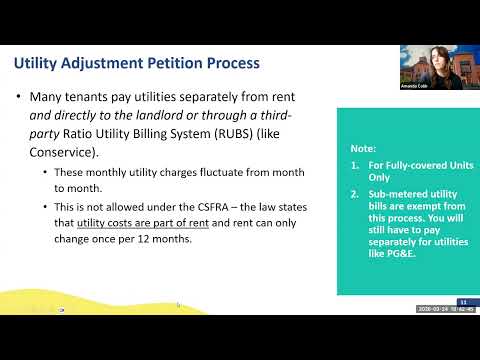
The presenter, a city housing division staff member, told attendees that "the definition of rent includes utilities," which means utility charges paid through the landlord count toward rent and are therefore subject to rent-increase limits that allow only one rent change per 12 months.
Why it matters: Under CSFRA, monthly fluctuations in utility charges paid separately by tenants would conflict with the rule that rent can only change once a year. The petition process aims to convert those variable monthly utility charges into a stable, fixed amount included in rent so the utility portion is subject to the same annual general adjustment (AGA) as rent.
What utilities and units are covered: The presenter said utilities paid by tenants to their landlord or a third-party billing service—commonly water, sewer and garbage, and sometimes electricity or gas—are counted as rent. Charges that tenants pay directly to a utility provider (for example, PG&E) or units with submetering are exempt. The process applies only to units fully covered by CSFRA; it does not apply to partially covered units, mobile homes or properties that are 100% affordable housing.
How the adjustment is calculated: Staff review the propertywide utility bills submitted by landlords for the 07/01/2023–06/30/2024 billing period, subtract estimated common-area usage (pools, landscaping, shared laundry), and allocate the remaining charges to individual units using unit-level information (number of rooms, bedrooms, kitchens and living spaces).
Filing, notice and tenant response: Landlords submit a propertywide petition with per-unit calculations. Staff check the filing for completeness; when a petition is complete the landlord serves tenants and files with the city. The division then mails a notice of filing and provides a tenant response form; tenants have 30 days from receipt of the tenant response form to contest inaccuracies. The presenter said tenants should carefully review the anonymized workbook that accompanies the petition and verify move-in dates, unit makeup and the history of any prior rent increases.
Timing for adjustments: If the final determination produces a downward adjustment for a unit, landlords must issue a rent-decrease notice within 30 days of the office finalizing the process and the decrease will be incorporated into rent about 60 days after finalization. If the determination is an upward adjustment, landlords may add the utility adjustment amount at the next legally allowed annual rent increase—typically one year after the tenant's last rent increase.
Assistance and next steps: The city will run a housing help center the first and third Thursday of each month from 6 to 8 p.m.; the presenter gave an in-person office location (298 Escuela Avenue) and a virtual attendance option. When a tenant identified on the call as DJ said, "I have not received the workbook form to check if it's accurate yet or not," the presenter advised first contacting the landlord and offered to email the workbook or contact the landlord directly to ensure the tenant gets the missing materials.
The presentation concluded with staff encouraging tenants to watch for mailed or emailed petition materials (some landlords may serve part of the packet by mail and part by email or post materials on unit doors) and to use the tenant response form within the 30-day window if information is incorrect. The city will finalize calculations after reviewing tenant responses and will notify landlords and tenants of the final determination.