DOT proposal for two‑way protected bike lanes on Lafayette draws safety, loading and bus concerns at CB2
Loading...
Summary
DOT presented plans to add a southbound protected bike lane and other upgrades along the Lafayette/4th Avenue corridor; residents and committee members pressed for block‑level parking/loading data, safeguards for seniors and schoolchildren, and clearer plans for signal timing and emergency access. CB2 voted to draft a resolution compiling those concerns.
Manhattan Borough DOT representatives outlined plans to close a gap in the city—ike network by adding a southbound protected facility on Lafayette Street and related upgrades along the Lafayette/4th Avenue corridor, prompting sustained public comment and questions from Community Board 2 members about pedestrian safety, truck loading and bus operations.
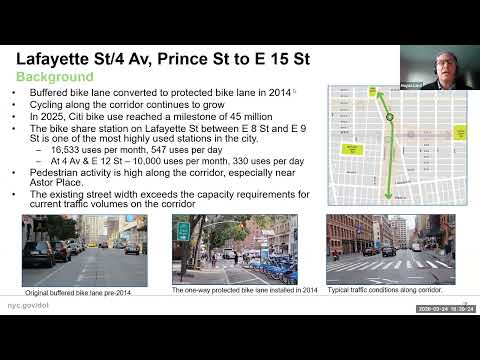
"There is no southbound protected bike lane," Hayes Lord of the DOT cycling and micromobility unit said as he described the project and the agency—ffort to connect existing two‑way facilities at Union Square and south toward the Brooklyn Bridge. DOT staff said the work would link to planned repaving and that several cross‑section options are under consideration, including one that narrows motor vehicle space to add a two‑way protected bike facility and an amenity strip for bike/cargo parking and landscaping where feasible.
The presentation listed block‑level elements DOT is proposing: relocation of a Citi Bike station near Wegmans to the south side of Astor Place to free space for the two‑way lane; added signal treatments and split phases at multiple intersections to reduce conflicts; new concrete islands and sidewalk extensions at several crossings; and replacement of flexible delineators on 13th Street with low‑profile concrete barrier segments where repaving allows. DOT said the concrete segments would be intermittent ("20 and 40 feet" in many locations) to maintain permeability for loading and emergency access.
Committee members asked for and DOT agreed to provide detailed parking and loading inventories for each block, as well as the agency—ount data used to reach the design decisions. "If we don't see that it's working well with the next resurfacing, we can make that change," Lord said regarding lane counts, and DOT told the board it will share slide materials and the Automatic Traffic Recorder (ATR) 24‑hour counts it used for analysis.
Public commenters raised recurring themes. Residents of the Stewart House and parents from Grace Church School warned that two‑way bike lanes on a one‑way street would be confusing for pedestrians and dangerous for seniors and small children. "I'm very afraid of having a two‑lane bikeway between 8th Street and 12th Street," a Stewart House resident said, citing heavy truck unloading and concentrations of elderly residents and schoolchildren.
Local cyclists also described collisions and close calls on the existing Lafayette alignment and urged DOT to consider alternative southbound routings such as Broadway or 3rd Avenue for parts of the connection. Several commenters asked DOT to pilot or show an operational example of a two‑way protected lane in an area with similar pedestrian volumes so the community can evaluate likely interactions.
DOT responded with multiple mitigations it is proposing: split Leading Pedestrian Interval (LPI) signals at Prince, East Howson and Great Jones; fully split signal phases at East 9th and East 13th Streets where turning conflicts are greatest; intermittent concrete barrier segments where repaving permits; and enlarged amenity strips for cargo bike parking and refuge space. DOT staff also said it has started outreach to elected officials, community boards 2 and 3, the hospital and schools along the corridor, Wegmans and other neighborhood stakeholders.
Several commenters expressed concern about preserving transit speed and emergency vehicle access where the project narrows travel lanes. DOT said it plans turn lanes at 12th, 13th and 14th to peel turning traffic out of through flow and expects buses to continue to serve curbside stops; the agency said FDNY apparatus can operate on the planned 11‑foot lanes.
Board members and members of the public asked DOT to supply the design manual or industry guidance DOT used for two‑way lanes on one‑way streets. DOT said its engineers draw from national standards and internal manuals and agreed to share the relevant guidance and the data that supported its traffic‑volume and safety analysis.
At the meeting's end, Community Board 2 voted to draft a resolution that affirms support for improved two‑way bicycle connectivity while pressing DOT to incorporate specific safeguards: a block‑by‑block parking/loading inventory, clear plans for loading/permeable barrier spacing for deliveries and hospital access, pedestrian safety treatments near schools and senior housing, and a timetable for monitoring and revisiting lane changes after repaving and initial operations. The board also scheduled a field walk along Lafayette (Petrosino Square north to 14th Street) to inspect conditions in person.
DOT representatives said they would continue outreach and return with design tweaks after meeting more stakeholders. The agency agreed to provide the board with slide materials, the ATR 24‑hour counts used in the study, and its list of outreach contacts.
The committee adjourned after agreeing to compile public testimony and forward a resolution to the full board for ratification.