Get Full Government Meeting Transcripts, Videos, & Alerts Forever!
Get email alerts on the Public Health topic
No spam. Unsubscribe anytime.
Mesquite authorizes abatement at home after staff documents at least 260 rats
Summary
The city approved staff direction to abate unhealthful conditions at 574 Condor Street after code enforcement described a multi‑week response, animal control reported capturing at least 260 rats, and neighbors reported health and quality‑of‑life impacts; the city will clean the property and seek cost recovery via a lien.
Mesquite — City Council on Sept. 9 authorized staff to abate unhealthful conditions at 574 Condor Street after staff described repeated code-enforcement efforts and animal-control trapping that officials said yielded at least 260 rats.
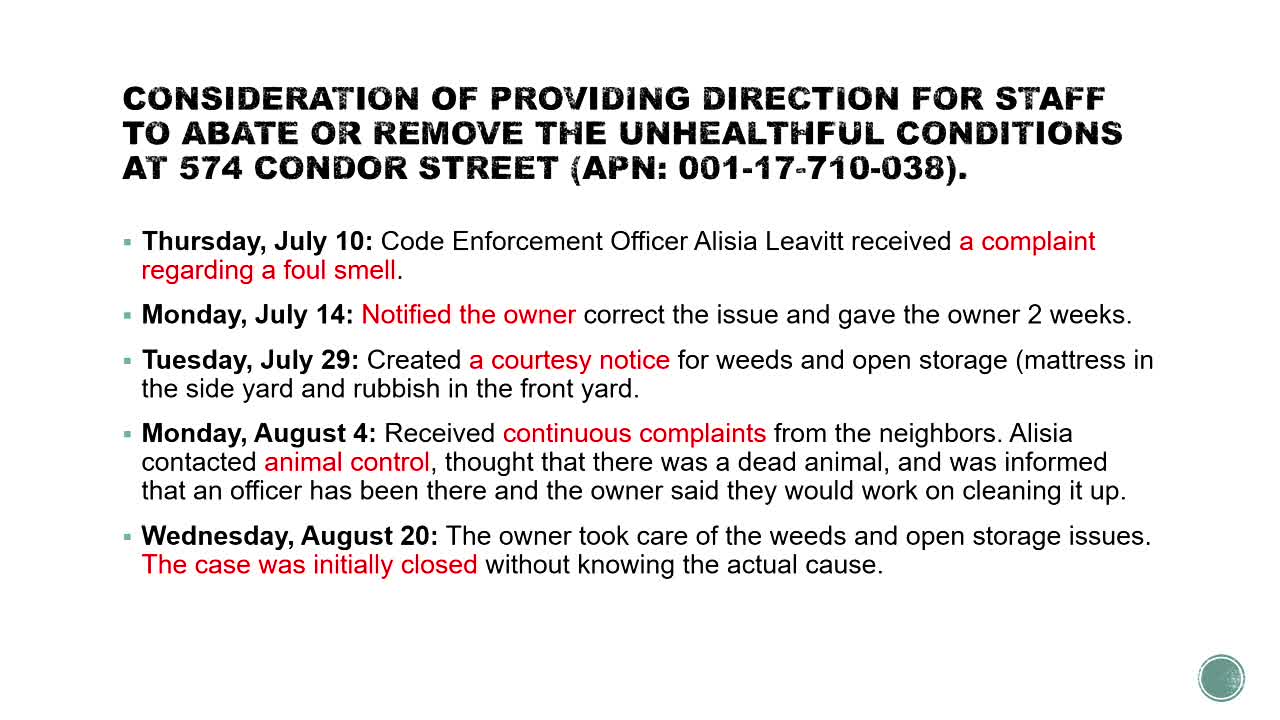
Development services staff summarized a months‑long enforcement chronology: code complaints, notices to the owner, a temporary closure of the case after some remediation, recurring complaints and a subsequent rat infestation that prompted animal-control intervention. “For a couple of days ... animal control ... caught approximately 40 rats” early in the response and later captured about 200 more, staff said; combined totals cited to council were “a minimum 260” rats and possibly more.
Staff told council the property owner eventually signed an agreement allowing the city to abate the hazard and record a lien to recover abatement costs; the recommended scope included hiring certified rodent‑pest control and possibly a professional hazmat cleaning. Building official Ben Russo described site work already done with dumpsters and tree‑trimming requests and said extensive remediation would be expensive for an owner with limited means.
Neighbors described ongoing problems across the block. “They’re already over there … They’re spreading,” Gabriela Ponce said, describing sightings in nearby Grapevine Villas. Several residents said efforts to help the homeowner were rebuffed at times and expressed frustration at recurring conditions that affect property values and create a public‑health risk.
Council members pressed staff on assistance for impacted neighbors and long‑term prevention. Staff said the priority is to remove the source and then monitor surrounding properties; they noted some temporary municipal assistance (traps placed in adjacent yards) but said routine pest control is not a city function and future professional services would be charged to property owners unless emergency action was required.
Councilwoman Fielding moved to direct staff to abate the property and place a lien for city costs; the motion passed. Staff said they would hire professionals to clean and abate the property and return with cost estimates and next steps for recordation of a lien as allowed by the owner’s agreement.
Next step: staff will contract for professional abatement and provide cost estimates; council authorized abatement and lien recording.