Get Full Government Meeting Transcripts, Videos, & Alerts Forever!
Get email alerts on the Budget topic
No spam. Unsubscribe anytime.
Superintendent presents 2026-27 budget with proposed 2.11% town tax-rate change
Summary
Superintendent Dr. Hatter presented the Yorktown Central School District—s final 2026-27 budget proposal, citing a 2.86% budget-to-budget increase and an estimated 2.11% tax-rate change for the town of Yorktown; the presentation kept existing programs while noting staffing needs, a $68,000 SRO contract increase, and a timeline leading to the May 19 budget vote.
Superintendent Dr. Hatter presented the Yorktown Central School District—s final budget proposal for 2026-27, saying the plan keeps current programs intact while balancing taxpayer sensitivity and student needs. He told the board he is proposing a 2.11% tax-rate change in the town of Yorktown and described the budget-to-budget increase as 2.86% with a levy change of 2.38%.
Dr. Hatter said the district serves about 3,400 students and emphasized maintaining high-quality programs including universal prekindergarten (UPK), special education services led by Miss Almeida—s department, and expanded academic offerings. He highlighted potential new courses such as AP cybersecurity and AP business and personal finance and said the budget includes clinical and technology positions and contingency staffing to respond to enrollment changes.
"The budget of a district really tells the story of that school district," Dr. Hatter said, and later added that the proposal "balances a profound sensitivity to taxpayers with the best interest of our students," language he used to frame program and staffing choices.
Key drivers of the proposed budget include an estimated $68,000 increase in the school resource officer (SRO) contract, higher health insurance costs, lower state teacher retirement system aid, transportation cost increases and higher energy rates. The superintendent reported 10 teacher retirements and four resignations so far this year and said the district expects to replace approximately nine of those positions; some other roles are contingency positions tied to enrollment.
Dr. Hatter described capital work and financing as on track, citing a bond project that is moving on time and within budget and noting the district—s strong credit (AA+ cited in the presentation). He also said district leaders use fund balance annually to offset some increases and that final state aid numbers remain a material uncertainty until the state release (the district expects official numbers after mid-April).
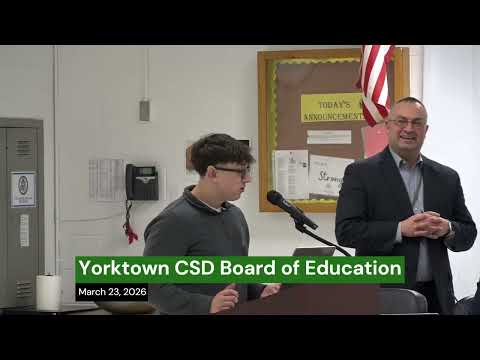
Student voices were part of the meeting: Luke Evangelista, a junior and student ex officio, described academic opportunities at Yorktown High School, including college credits earned through SUNY Albany and Syracuse University. "Yorktown High School has allowed me to explore my academic interest," Luke said, noting he will have earned 18 college credits by the end of his junior year through dual-enrollment and AP work.
Dr. Hatter outlined next procedural steps: a shorter board presentation at the April 13 meeting, a budget adoption on April 20 if there are no changes, a budget hearing on May 11, and the public budget vote and trustee election on Tuesday, May 19, to be held at French Hill School with polls open from 7 a.m. to 9 p.m.
What the budget means for taxpayers will depend on final state aid and local assessments; Dr. Hatter said the proposal is within the state—s allowable tax-levy cap and does not require an override. He encouraged community members to register to vote with the district clerk, Yvette Siegel, and to participate in the May vote.
Votes at a glance: the board approved motions by voice vote during the meeting, including the motion to adopt the listed policies (second reading and adoption of policies and regulations), a resolution denying a parental appeal for student alt ID 9729, approval of the consent agenda (personnel, business, curriculum, special education, and gifts/grants/donations), and adjournment. The meeting recorded voice votes with the chair calling for ayes and none opposed on the actions recorded.
The board—s budget presentation highlighted program continuity, staffing and enrollment uncertainty, and several cost pressures; the board is scheduled to consider any changes at its April 13 meeting before a likely budget adoption and the public vote in May.