Athens officials make case for 0.2-point income-tax increase, warn services could be cut if voters say no
Loading...
Summary
At a League of Women Voters town hall, Athens officials asked voters to approve a 0.2 percentage-point municipal income-tax increase estimated to generate about $1.9 million a year, saying the money would shore up employee health benefits and core services; they warned collections would begin in 2027 and the full effect may not be seen until 2028.
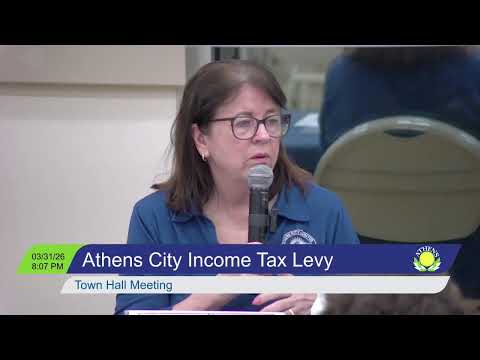
Athens officials urged voters to approve Issue 1 — a proposed 0.2 percentage-point increase in the city income tax — at a League of Women Voters town hall on March 30.
"What we're asking of the citizens of Athens is an increase in our income tax," Mayor Patterson told attendees, framing the request as a response to rising material and health-care costs and long-term revenue shortfalls. He said the increase would be ongoing, unlike several existing levies that expire on set schedules.
The city treasurer, Josh Thomas, told the audience the measure is expected to produce about $1,900,000 in additional annual revenue after the existing voter-approved levies are paid. "That would be, you know, after those 4, first 4 things that we talked about get paid, then it leaves us with $1,900,000," Thomas said, and said about 14.5% of that would go to the street fund (roughly $275,500) with the remainder flowing to general operations and the medical fund.
Auditor Kathy Hackt described shrinking carryover reserves and the need for contingency funds. "Our little savings account has been decreasing every year," Hackt said, adding that the city has discussed a levy for several years as reserves fell.
Officials described cost-control steps already taken, including a soft hiring freeze, an early-retirement incentive (the mayor said it takes effect May 1), and a recent internal budget review. They also warned that, if the levy fails, the city would likely harden hiring freezes, accept fewer full milling-and-repaving projects and make parks maintenance and some capital projects less frequent. "Potholes will continue to be filled," Mayor Patterson said, "but the remilling or milling and repaving of streets that have a score ... we will be doing fewer complete milling and repaving than what we've been able to accomplish in the past."
On employee health coverage, Treasurer Thomas gave specific figures: employee premium contributions of roughly $90–$150 per month (depending on marital status), an approximate per-employee annual cost of $23,500 into the medical fund, and medical-fund expenses of $5.7 million in 2025 (up from $4.9 million in 2024). He and other officials stressed that many cost-control options would require negotiation with four distinct unions. "That's a big one that we have to work with them," Thomas said of bargaining changes to benefits.
Several attendees asked why private residents should cover rising city benefit costs. Officials answered that the city relies primarily on income tax — not property or sales tax — for general revenue, and that competitive pay and benefits are important to retain police, firefighters and other staff. They also noted timing: the mayor said collections from a passed levy would not begin until 2027 and the full fiscal effect would likely not be realized until 2028 because of tax filing cycles.
Officials acknowledged a previous levy defeat and said they had reduced the ask (from 0.3 percentage points last year to 0.2 this year), improved outreach, and sought to clarify how the money would be spent. Moderator Tanya Konrath reminded attendees that early voting begins April 7 and that election day is May 5.
The town hall concluded with an appeal for questions and direct contact: Treasurer Thomas offered to send the information packet to any resident who requests it by email, and Konrath said a recording will be available on city and League channels.
The city did not take a formal vote during the town hall; the measure will appear on the May ballot.