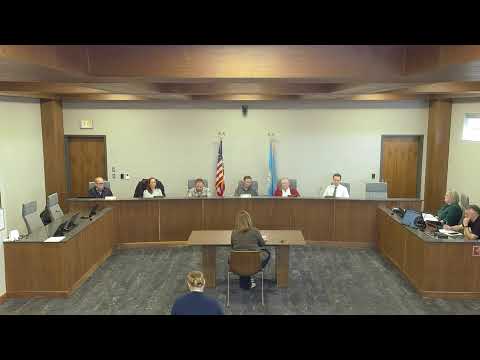
Staff briefs Madison commission on 2026 bills affecting local taxes, TIFs and permitting
Loading...
Summary
City staff summarized multiple 2026 state laws that give local options on sales-tax funding for property-tax relief, change TIF oversight and permit updates — measures the commission may need to consider for Madison's budget, codes and project approvals.
Staff member Jamieson briefed the Madison City Commission on key legislation from the 2026 South Dakota legislative session, detailing measures that could affect local tax options, tax increment financing and building codes.
The briefing noted that the legislature introduced 571 bills this year and sent roughly 240 to the governor. Jamieson said one bill, Senate Bill 96, allows counties to adopt an optional sales tax of up to 0.5 percentage points to fund a property-tax reduction program; he described it as a county-level option that counties may implement by ordinance or via voter initiative. “This is an optional sales tax,” Jamieson said.
Jamieson also outlined Senate Bill 245, which directs a future 0.3 percentage-point sales-tax increment toward a homeowner property-tax reduction fund beginning July 1, 2027, and advances $55,900,000 from state reserves to balance the state-aid formula for the 2026 payable-in-2027 cycle. “The 2026 payable, in 2027, gets $55,900,000 from state reserves,” Jamieson said.
On local project financing, Jamieson reviewed House Bill 1245 (the "CAPS" program), which permits communities to establish a capital improvement board and adopt a project-specific 1 percent sales tax to fund voter-approved projects. The bill requires a 60 percent voter approval threshold and limits the tax to the approved project; Jamieson said municipalities can structure projects as single large efforts or bundle several smaller items.
Tax increment financing was a focal point. Jamieson summarized the bill labeled 02/28: it tightens contiguous-district rules, prohibits some overlapping districts without county agreement, reduces the allowable total assessed-value share for first-class cities (Madison is included) from 10 percent to 7.5 percent, raises certain blight-percentage thresholds, and adds an independent third-party review requirement for proposed TIF projects. “This adds on the requirement for independent third party review as part of the approval process,” Jamieson said, noting reviewers must have no financial ties to the proposed development.
Jamieson also noted several other items: election-timing bills that allow municipalities to move local elections to even-numbered years by option, open-meeting law changes that require more specific agenda descriptions and add limited reasons for executive sessions (including cyber security and emergency-response planning), and a building-code update that permits municipalities to adopt the 2024 model codes effective July 1.
Commissioners asked clarifying questions during the presentation. Mayor Lindsey asked whether the SB 96 decision rests with county commissions; Jamieson confirmed the county controls adoption of the optional tax, though voters may also initiate ordinances. Commissioners discussed how the CAPS board would be composed (Jamieson said it is a five-member board with one governing-body member and four residents) and how the third-party TIF review could lengthen approval timelines but add transparency.
The staff packet and a municipal-league district meeting scheduled for Wednesday were cited as further resources for commissioners. Jamieson recommended reviewing the packet and noted Miss Blake, the league director, will present additional detail at the district meeting.
Votes at a glance: At the start of the meeting the commission approved the agenda by voice vote after a motion and second; the meeting adjourned by voice vote at the end of the session. Individual roll-call votes for those two routine motions were not recorded on the transcript.
Next steps: Staff recommended monitoring municipal-league guidance, verifying Madison’s current TIF-assessed-value percentage in light of the 7.5 percent cap, and evaluating whether any local ordinances or processes should be adjusted to comply with new open-meeting and code-adoption provisions.