Get AI Briefings, Transcripts & Alerts on Local & National Government Meetings — Forever.
Barrington 220 technology team previews device study, AI task force and infrastructure upgrades
Loading...
Summary
District technology leaders reviewed the 1:1 device program, a new device study (including the MacBook Neo), a 2025 refresh that prepared 10,000 iPads, expanded Wi-Fi and fiber upgrades, and an AI task force of about 70 teachers focused on classroom implementation and guardrails.
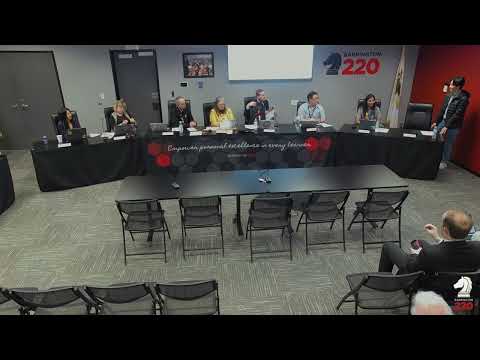
The Barrington CUSD 220 technology and innovation department presented a comprehensive update to the board covering device strategy, infrastructure projects, cybersecurity, student systems and digital citizenship.
Assistant Superintendent for Tech and Innovation (presenter) said the district has used iPads as its primary learning device across grades since 2019 and that a full device study requested by the board is already under way. The presentation noted a newly released Apple device, the MacBook Neo, and said the study will compare device features, long-term costs (including cases, stylus, management and repair/residual value) and instructional fit; preliminary cost comparisons still show the iPad as the most cost-effective option today.
District technology staff summarized major 2025 work: simultaneous refresh deployment of staff MacBook Airs and the preparation of roughly 10,000 iPads, integration of AppleCare into lease agreements to speed repairs and preserve residual value, migration to Incident IQ for ticketing and asset management, installation of 197 new wireless access points at the high school (nearly 700 APs districtwide), and new fiber optic cabling replacing decades-old infrastructure. The student information team reported expanded use of Infinite Campus and a recent point-of-sale upgrade for cafeteria transactions.
On AI and digital citizenship, the district described five classroom-facing AI skills (prompting and context engineering; check and choose; make corrections; create with AI; make cross-disciplinary connections) and an AI task force of roughly 70 teachers working from pre-K through grade 12. The team said vetted tools such as Brisk and Snorkel are used with teacher oversight, that district contracts and Google Workspace for Education guardrails limit use of student data for large-model training, and that tools go through cybersecurity and student-privacy vetting (CIPA/SOPA checks) before classroom deployment. "We don't want cognitive offload to machines," the professional learning lead said, summarizing the district's philosophy toward AI instruction.
Board members asked about keyboarding and college readiness with iPads; staff noted multiple typing/input options (on-screen keyboards, attachable physical keyboard cases available at schools) and said physical keyboard cases can be issued for students who need them. The technology department said it will re-administer surveys in May (staff and students) and add a parent survey later in April to track changes related to digital citizenship and device use.
What happens next: the department will continue the device study, conduct site visits, complete feature and cost analyses and return to the board with survey results and a recommendation timeline.