County staff report state review of animal-waste ordinance; DATCP suggests simplifying large-farm threshold
Loading...
Summary
Marathon County conservation staff said state agencies are reviewing draft animal-waste ordinance amendments and DATCP recommended changing the medium/large farm threshold from “300–999 animal units” to “300 or more” to avoid ambiguity for farms in the 1,000-unit permitting limbo; staff supported the change and said the draft may not reach the State Land and Water Board until June.
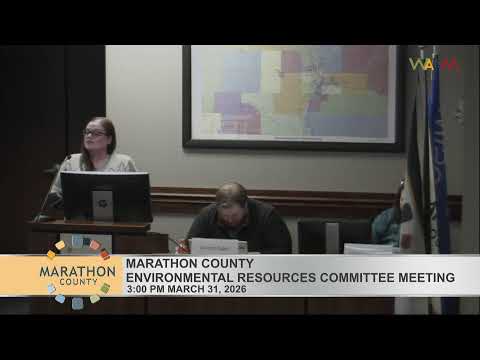
Marathon County conservation staff updated the Environmental Resources Committee March 31 on state legal review of proposed amendments to Chapter 11.02 — animal waste and cropland management.
County Conservationist Kirsty Heidenreich said the draft was sent to the Wisconsin Department of Agriculture, Trade and Consumer Protection (DATCP) and the Department of Natural Resources in early January and that the state review process can delay the county’s timeline because the State Land and Water Board meets only every other month. She said DATCP suggested a minor but substantive phrasing change: replace the current draft language that references farms “300 to 999 animal units” with wording that says “300 or more animal units.” According to staff, the rationale is to avoid ambiguity for farms that are in transition toward becoming state-permitted concentrated animal feeding operations (CAFOs) but do not yet hold a permit.
"We recently did receive a suggested change from DATCP ... they had suggested that instead of us saying in our ordinance 300 to 999, we simplify it to say 300 animal units and up from there," Heidenreich said. She added the county already defers to state rules that prohibit spreading liquid manure for farms of 1,000 animal units and larger during February and March.
Heidenreich told the committee staff and a farmer work group reviewed the recommended change and supported it; she said the county hopes the ordinance can be scheduled for a State Land and Water Board agenda but that timing will be decided by state staff. No formal committee vote was taken; staff said the ordinance will return to ERC after state review and, if necessary, to the County Board.
Why it matters: the proposed change narrows possible interpretation gaps around large farms that are between 300 and 1,000 animal units and those seeking DNR permitting at 1,000 units or more. Committee members asked about the timeline and whether substantial edits would require re-submittal to DATCP; staff said minor edits can be coordinated with corporation counsel but substantive draft changes could require another state review.
Next steps: staff will continue communication with DATCP and DNR, report significant developments to ERC, and bring revised language back to the committee after state review.