Cedar City Council advances review of proposed Suncor concrete batch plant after noise study and water questions
Loading...
Summary
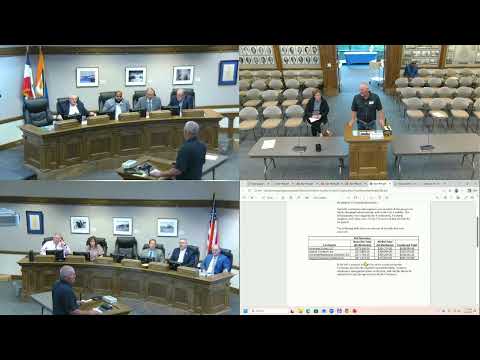
After an hours-long presentation and a late-arriving noise study, the Cedar City Council voted to place the conditional-use permit for a proposed Suncor concrete batch plant on next week's action agenda, directing staff to finalize defensible mitigation conditions for traffic, dust, noise, water protection and buffering.
The Cedar City Council voted to place for action next week a conditional-use permit request from Suncor (presented by Clyde Companies) for a 100-foot‑plus concrete batch plant on land near Highway 56 and 800/600 North, after staff described mitigation conditions and an independent noise study largely cleared the project to meet common local standards.
City planner Don (staff) told the council the CUP process exists to allow potentially impactful uses in appropriate zones if conditions reduce harms. Staff identified the primary concerns as vehicle routing, fugitive dust and air-quality controls, noise, water protection for nearby well zones, lighting/photometrics and visual buffering; staff also recommended limits on silo signage and a site‑obscuring fence.
Greg Flint, a Clyde Companies real estate manager representing Suncor, said the plant would be a wet‑batch facility with enclosed silos and a closed system for cement and fly ash, and that aggregates would be washed before delivery. He said traffic would be routed east to Lund Highway to avoid neighborhood streets and that the operation would generally start around 4 a.m. with occasional early or late pours for large jobs.
"We're about building a better community," Flint said, describing multiple design changes the company made with staff to lower noise and dust and to improve circulation and staging so trucks remain on site.
Council members pressed the applicant and staff on several technical points. One councilor asked whether the tree requirement in the conditions accounted for existing mature vegetation near the well; another asked whether a 100‑plus‑foot structure was acceptable near the airport; staff said the FAA review allowed the proposed height and the applicant confirmed they submitted and received FAA clearance for the height limit the FAA provided.
Noise emerged as the most technical sticking point. Acoustic consultant Claire Pincock explained her firm calibrated a model using measurements from comparable plants and that, after the applicant's design changes, the modeled project generally meets common Utah daytime L90/L10 guidelines and meets nighttime L10 guidance. The consultant said projected nighttime L90 levels are about 2 decibels above the guideline in the worst modeled scenarios. "Two decibels is not very much," she told the council, adding that a 10‑decibel change would be perceived as roughly a doubling of loudness.
Council members and staff discussed landscaping and fencing as visual and psychological buffers; the consultant noted trees produce limited measurable noise reduction at the distances considered and have primarily visual benefits. The applicant proposed a "triangle" line‑of‑sight approach for placing evergreen trees along a sight corridor and agreed to an 8‑foot block fence along the adjacent property line.
Water and firefighting capacity drew pointed questions: council members warned a single feed off Lund Highway currently serves hundreds of homes and asked whether the plant's daily water use or wash‑water ponds could exacerbate low fire flow downstream. Ray Nelson, area manager for the applicant, said a typical batch uses roughly "300 gallons or so for 10 yards of concrete," and described lined wash ponds and recycling plans; he said the project team would work with city engineers to ensure best management practices and secondary containment for any above‑ground storage.
Legal counsel and staff repeatedly urged the council to frame conditions to mitigate quantifiable harms and to avoid imposing requirements that would be legally difficult to defend. Councilmembers were asked to review the red‑line conditions in the packet and be prepared to choose final wording at next week's meeting.
The council closed the public hearing after a planning commissioner who sat through the earlier proceedings said the planning commission had unanimously supported the planning commission's proposed tree placement as "fair and reasonable." The council then voted to place the CUP on the action agenda for next week so members could finalize a set of conditions and take a formal vote.
Next steps: council members will review staff's red‑line conditions and the updated noise study; the item will return for an action vote next week.