Lifetime Citizen Portal Access — AI Briefings, Alerts & Unlimited Follows
Southborough planning board presents major update to Industrial Park zoning, adds rules for data centers and clean energy
Loading...
Summary
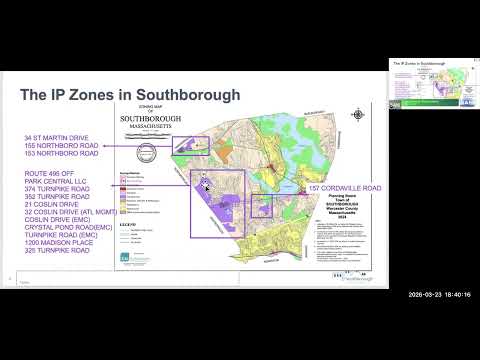
Planning board member Marnie Houlihan walked the board through Article 17, a comprehensive update to the 40‑year‑old Industrial Park (IP) bylaw that modernizes permitted uses, adds environmental and safety performance standards, and creates a planning‑board special‑permit track for data centers; the public hearing was continued to April 11.
Marnie Houlihan, a planning board member, presented Article 17 on March 23, describing a multi‑part rewrite of the Industrial Park (IP) zoning aimed at modernizing uses and protecting nearby neighborhoods.
Houlihan said the amendment (Article 17) would: update permitted uses to reflect contemporary industry; enact performance standards for noise, odor, vibration and lighting; strengthen fire, life‑safety and emergency planning; and incorporate the state’s small clean energy infrastructure law. “We are mandated to incorporate this into our bylaw by October 1,” Houlihan told the board, urging the town to adopt the state guidance with local protections.
Under the proposal, uses up to 50,000 square feet would be allowed by right; anything larger would require a special permit. Houlihan said the bylaw would move data centers into a special‑permit category, with the planning board — not the zoning board of appeals — acting as the permitting authority for those projects. The draft sets new setbacks: 100 feet from residential and conservation land for general IP development and 1,000 feet for data centers and specified clean energy infrastructure.
The amendment also adds public‑engagement and mitigation requirements for larger projects. Houlihan said applicants would be required to hold at least two neighborhood meetings and notify residents within a half‑mile; the bylaw would require pre‑ and post‑construction noise studies and strict limits on generator testing. She told the board the planning board could deny a permit if impacts could not be adequately addressed.
Board members asked for clarifications about use listings and examples of what 50,000 square feet looks like in practice; Houlihan used comparisons (an elementary school, a supermarket, or about 1.15 acres) to give context. Members also suggested posting the compare‑and‑contrast materials and three recorded videos Houlihan prepared to the planning board web page so residents could review them before town meeting.
The board voted to continue the public hearing on the IP amendment to 9 a.m. on April 11 so members and the public can review the full compare/contrast packet and follow up questions.
Next steps: the planning board will hold the continued public hearing on April 11, ahead of the town meeting where Article 17 will appear on the warrant. If adopted at town meeting, the change will impose the new special‑permit process and the updated setbacks and performance standards described by Houlihan.