Laredo council begins budget cycle, flags constrained revenues and $40—3050M in proposed CIP debt
Loading...
Summary
City leaders used a March 25 workshop to outline a fiscal picture driven by rising personnel and benefit costs, lower-than-expected sales-tax and bridge-toll revenue, and a proposed capital program that staff said could use $40—3050 million in bonds depending on priorities and grant availability.
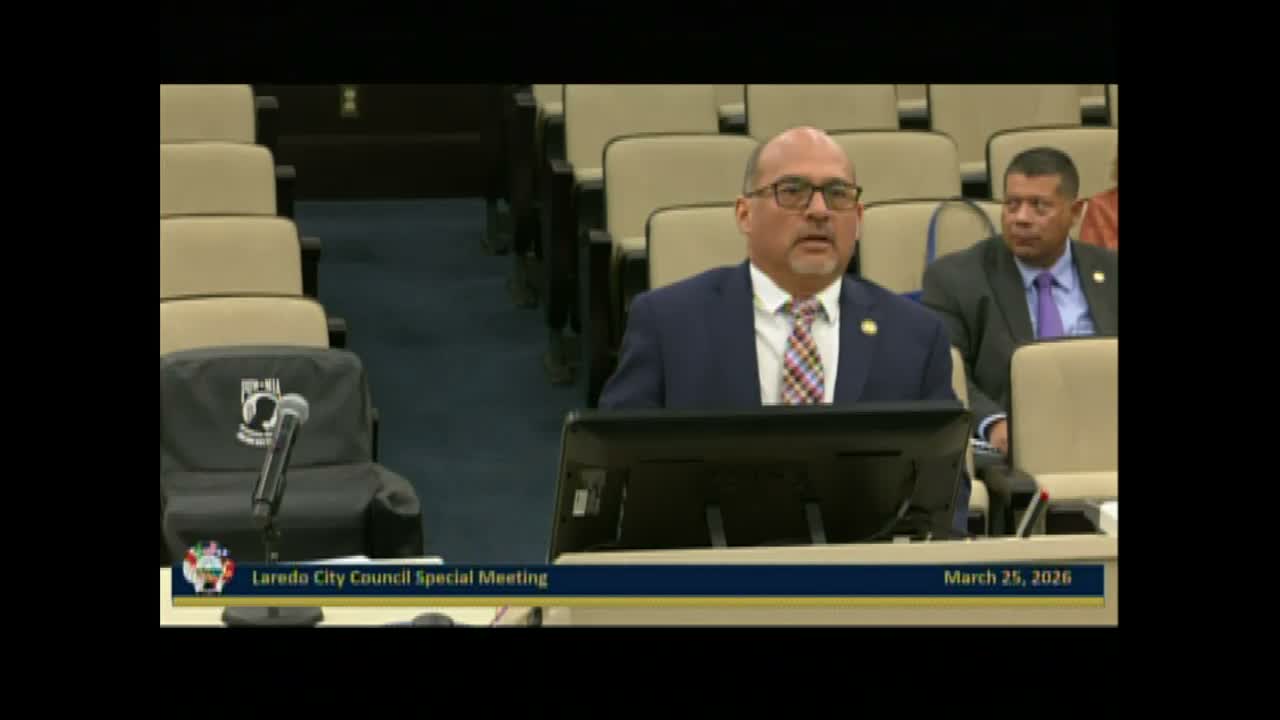
The City of Laredo convened a special council workshop on March 25 to lay out the financial reality that will shape the fiscal 2026'27 budget, with staff warning that most revenues are already committed to core services and that structural cost pressures will require trade-offs.
City Manager (identified in the record as Mr. Knapp) and budget staff told the council that more than 88% of current spending supports core services such as police, fire, streets and utilities. The staff presentation listed personnel, health insurance and retirement as primary cost drivers that must be addressed through a combination of revenue strategy and operational changes.
Why it matters: Budget staff and the city manager said revenues are not keeping pace with rising costs, so council will need to decide which projects and programs to prioritize. Staff recommended conservative revenue assumptions for planning and emphasized that not every project can move forward this year.
Budget calendar and revenue picture: Budget staff recommended a schedule that includes a second workshop on May 13, a proposed rescheduling of a June workshop to June 4, a formal submission to council on July 22 and a final workshop July 29. The presentation showed property taxes as the city's largest general-fund revenue line, with staff projecting a modest increase in the year-end property-tax receipts. Sales-tax collections through the five-month period were about 5.1 percentage points below budget, and bridge transfers (the city's share of toll proceeds) trended roughly 7% under budget in the same period, staff said.
Capital Improvements Plan: Engineering and budget staff described a 5-year CIP (with a 10-year planning horizon) and explained a prioritization framework that ranges from legally mandated projects to desirable, quality-of-life investments. Preliminary candidate projects for FY27 listed by staff included a convention center, port police substation, Tiny Homes phase 2, a secondary-water initiative and various road and bridge grade-separation projects. Staff said they anticipate issuing general-obligation bonds in the $40—3050 million range and continuing to pursue tax notes, grants and other financing as needed.
Council questions and next steps: Councilmembers pressed staff on the timing of CIP decisions and on coordination with Webb County and federal partners for projects such as bridge expansions. City staff said bridge-expansion costs would be financed from bridge revenues (separate from the general-obligation bond pool) and noted federal permitting timelines (presidential permits) that affect scheduling. Staff will return to council with refined project lists, funding scenarios and the impact of alternative revenue assumptions ahead of the formal budget submission.
The workshop produced no final votes on projects or appropriations; it established the background, assumptions and timeline that will guide later budget decisions.