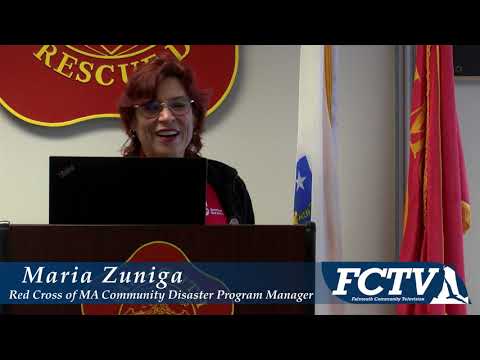
Red Cross outlines local sheltering, smoke‑alarm program and volunteer limits at Falmouth LEPC meeting
Loading...
Summary
Maria Sudega of the American Red Cross told the Town of Falmouth LEPC about sheltering capacity, the Home Fire Campaign’s free smoke-alarm installations and limitations caused by volunteer staffing; she urged local partnerships and donors to support short-term disaster response.
Maria Sudega, community disaster program manager for the American Red Cross, told the Town of Falmouth Local Emergency Planning Committee (LEPC) that the Red Cross provides short-term sheltering, meals, supplies and casework after local disasters but depends heavily on volunteers and donated funds.
"I'm going to be driving to Brockton at 02:00 in the morning," Sudega said, describing how staff and volunteers sometimes travel overnight to support multi-family fire responses. She described regional capabilities — two equipment trailers and roughly 100 cots — and said teams also provide registration, feeding and mental‑health first response while community partners supply meals.
The presentation focused on the Home Fire Campaign, through which Sudega said her teams install free smoke alarms and carbon‑monoxide detectors and conduct education and planning for households, emphasizing multi‑generational needs. "We provide free smoke alarms and carbon monoxide detectors to the population free of charge, and we install them," she said. Sudega said the program has documented 2,615 lives saved since its start in the region.
Sudega stressed the Red Cross’s limits: it is not a licensed electrician and cannot bring a home up to code, but the organization will install battery‑backed alarms and specialized devices by referral for residents who are deaf or hard of hearing. She said the Red Cross can supply strobe lights and bed‑shaker alert devices through partnerships with agencies such as the Massachusetts Commission for the Deaf.
On shelter staffing, Sudega said the Red Cross provides shelter managers and trained shelter workers for tasks such as setting cots, registration and feeding, but it generally cannot supply continuous nursing shifts. Volunteers include retired clinicians and licensed mental‑health providers who offer short‑term support; Sudega said her team typically contacts affected families within 24 hours and provides casework and referrals to local partners for longer needs.
Sudega noted operational safety rules that can limit deployments: when the Red Cross issues a "ground stop" because of severe weather or other hazards, volunteers are not sent into dangerous travel conditions. To avoid that problem, she urged towns to pre‑stage volunteers and supplies when forecasts indicate a major storm so shelters can open early and operate safely.
On funding, Sudega said the Red Cross is not federal or state funded and relies on donations; she stated that a high share of donations goes to disaster relief. She also described short‑term financial help for displaced residents in the form of debit cards for essentials and said amounts are modest ("a couple of $100" for a single person), with negotiated hotel rates sometimes used to place families temporarily.
Members asked about local contact points and coordination. Sudega said sheltering decisions in a "perfect world" involve the town emergency manager, the school superintendent (for school shelters) and disaster partners; she offered to coordinate referrals and to work with the town’s human services staff to connect families to longer‑term services after the Red Cross’s typical 15‑day assistance window.
The LEPC closed its meeting by thanking Sudega and announcing the next monthly LEPC meeting will be April 23 at 611 Gibbard Street and that a tabletop exercise with Massachusetts Maritime students is scheduled for May 28 in the training room.
Sudega left contact information and encouraged residents to sign up for the Red Cross preparedness app, take hands‑only CPR training, and donate blood to help maintain local emergency capacity.