Public Works committee advances street, sidewalk, Main Street and wetland planning measures
Loading...
Summary
The Public Service committee advanced a set of infrastructure and environmental proposals: an $1.8M concrete‑rehab program (with $1.2M OPWC grant), a $1M sidewalk program covering 272 properties, Main Street phase‑3 design ($10M project; $71k to finish design), a $500k EPA wetland mapping grant application, and authorizations related to WRF electrical and loan funding.
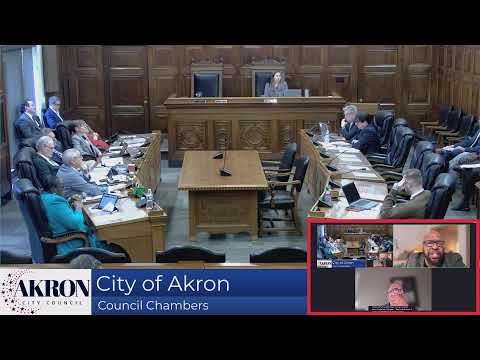
The Public Service, Public Utilities and Green Committee considered a multi‑item agenda addressing capital projects and environmental planning.
Service Director Chris Lottle described the annual concrete street rehabilitation program (roughly $1.8 million in this year’s capital plan) and noted an Ohio Public Works Commission (OPWC) grant award of $1.2 million; staff said bidding will proceed but noted the OPWC funds are not payable until July 1 and that some streets will receive localized slab replacement rather than full reconstruction.
The committee also reviewed the annual sidewalk petition program (the city expects to address 272 properties under a roughly $1,000,000 allocation) and a traffic‑calming ordinance to remove a through‑street designation on Delia Avenue to establish a uniform 25 mph corridor.
On Main Street Corridor Phase 3, staff described a federally funded reconstruction that will remove the center median and complete final design; the project was described as a $10 million construction effort with about $71,000 needed to finish design documents and make the project biddable. Staff proposed contracting directly with GPD Group for this final design phase.
The committee approved ratification of an emergency contract related to a Route 59 median/failed storm‑sewer repair, and staff sought suspension to allow quick action on an EPA Region‑5 wetland mapping grant application ($500,000) to create the city’s first comprehensive municipal wetland GIS layer for planning and restoration. Finally, members discussed Water Reclamation Facility (WRF) secondary‑treatment electrical improvements and a companion Water Pollution Control Loan Fund application; staff described the technical need (switch‑gear and automatic generator transfer for high‑voltage blowers) and said they expect a 28‑year loan at current market rates to finance the work.
Most items were moved on consent or with suspension of rules where timing warranted. Council members asked clarifying questions about schedule, ward impacts and coordination with schools for timing of work near school entrances.