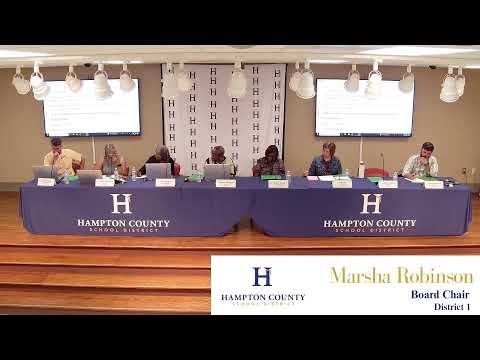
Hampton County board reviews preliminary 2026–27 budget, flags $3.7 million shortfall and rise in contracted services
Loading...
Summary
At a March 31 called meeting the Hampton County School District reviewed a draft 2026–27 budget that projects a roughly $3.7 million gap and a large increase in purchased/contracted services; staff said the plan is a work in progress and will return for a first reading April 21.
The Hampton County School District Board of Trustees on March 31 reviewed a preliminary 2026–27 budget that staff said leaves an estimated $3,739,021 gap and relies heavily on contracted services to fill vacancies.
Superintendent Dr. Sheffield opened the session by describing the draft as an interim product “to allow you to see where we are so we can gauge and have continuous conversation,” and turned the presentation over to budget presenter Miss Karklajian, who walked the board through revenue and expenditure assumptions.
Miss Karklajian, the presenter, said state proposals from the House include a $2,000 per-teacher supplement and required step increases; she said she modeled an average 4.6% increase for teachers by combining the $2,000 supplement and steps. She told the board the district’s current state and reimbursement totals are roughly $19.99 million and the proposed figures rise to about $20.36 million, while total proposed general fund revenue was presented at about $33.07 million — an increase over the current year but still short of proposed expenditures.
On the expenditure side, the presenter showed total proposed salaries rising to about $19.07 million (an increase of roughly $971,953) and fringe and benefits increasing markedly to roughly $9.55 million — a rise several board members said merited closer review. Purchased services (contracted services) were listed as increasing by approximately $2.5 million, driven in part by contractors filling certified vacancies and by specialty services such as occupational therapy and psychologists.
"When we start doing the psychologists and you start doing those specialties like that, those prices go up even higher than your teacher," Miss Karklajian said, explaining why contract spending has risen. Board member Ford pressed staff on the relationship between salary increases and the larger fringe increase, saying the fringe change "just seems high" and asking the administration to recheck the calculations to avoid double-counting contracted services and fringe.
Presenter figures showed a projected deficit (revenues minus expenditures) of about $3,739,021 and a fund-balance estimate of roughly $1,276,174 at year-end under the current draft. Officials said they hope to avoid using prior-year fund balance but included prior transfers in the draft as a contingency while they work to balance the budget.
Staff discussed a long vacancy list across schools and described many roles currently filled by contractors (recorded in the budget as purchased services). Presenters said some requests were reduced from full FTEs to 0.5 FTEs across schools, and some new position requests (for example certain instructional or specialized roles) were denied or marked pending as they weigh student counts and district priorities.
Superintendent Dr. Sheffield told the board staff would continue to reconcile numbers during the break and return for a first reading on April 21. She emphasized the need to use data when making trade-offs and said staff will prioritize balancing the budget while reviewing vacancies and contracted positions.
The board did not take a formal budget vote at the meeting; members asked staff to revisit fringe calculations, clarify where contracted positions may be shifted to district hires to reduce purchased services, and provide a refined draft for the first reading.