Get Full Government Meeting Transcripts, Videos, & Alerts Forever!
Get email alerts on the Surveillance Alpr topic
No spam. Unsubscribe anytime.
Bell Gardens Council Extends License-plate-reader Contract for One Year, Adds Monthly Audits After Heated Debate
Summary
After a lengthy public debate and public comment opposing surveillance, Bell Gardens approved a one-year extension of its Flock Safety automated license-plate reader agreement with limited sharing and a requirement for monthly internal audits; the council voted 4–1. The extension costs $57,500 a year; termination would carry an $11,500 fee.
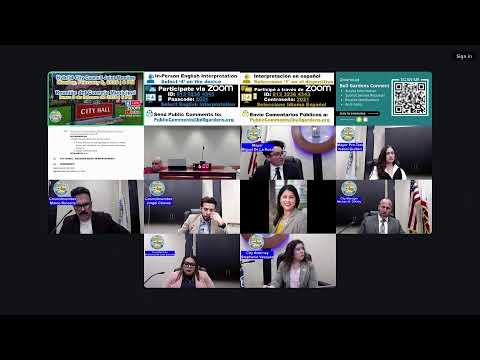
Mayor Miguel de la Rosa and a majority of the Bell Gardens City Council voted Feb. 9 to extend the city's agreement with Flock Safety for one year while maintaining limited data‑sharing settings and instituting monthly internal audits by the police department.
The motion, advanced by Mayor Miguel de la Rosa and approved on a 4–1 roll call, keeps the current setup and buys time for policy review; council member Barzana voted no. The police department and vendor said the annual extension cost will be $57,500; staff told the council that terminating the agreement now would trigger a one‑time $11,500 termination fee and yield an estimated $1,800 credit back to the city once equipment is removed.
The vote came after more than two hours of presentation, public comment and questions that centered on privacy risks, regional data‑sharing and procedural safeguards. Pastor Richard Jarman, who submitted a public comment card, urged the council not to renew and said, “The automated license plate readers are an unneeded and unwanted invasion of the privacy of every resident of the city.”
Police officials described the system's investigatory benefits and controls. Lieutenant John Acosta, who led the department's presentation, said the 23 fixed cameras currently deployed do not use facial recognition or biometric identification and that searches generally require an incident type and case number, telling the council, “One key thing to note is that the cameras do not use facial recognition or any biometric identification.”
Trevor Chandler, director of public affairs for Flock Safety, answered technical and policy questions and described product safeguards his company has rolled out, including mandatory crime‑code fields for searches (NIBRS codes), permanent audit logs of all searches and forthcoming proactive auditing tools that flag unusual search behavior. Chandler said those audit records are permanent and that the company has implemented state‑specific firewalls to restrict out‑of‑state access tied to immigration or reproductive‑health queries.
Council members who opposed immediate termination said the system remains a useful investigative tool even with restricted access. Those urging termination or tighter limits cited ACLU reports and argued the technology can produce detailed travel histories that risk misuse, especially for vulnerable immigrant residents. The council discussed how transparency portals display "hits" (notifications when a hot‑listed vehicle passes a camera) and how misreads and multiple camera views of the same vehicle can inflate those counts.
Under the approved motion the city retains the cameras and the current limited‑sharing configuration; the police department will conduct monthly internal audits to review searches and usage. The council directed staff to continue evaluating policy options and report back as needed.
The decision leaves the city with continued operational access to ALPR alerts while tightening routine oversight; the council did not direct immediate termination of the program. The ALPR item was recorded as agenda item 11.2 and the roll‑call vote was recorded in the meeting minutes.