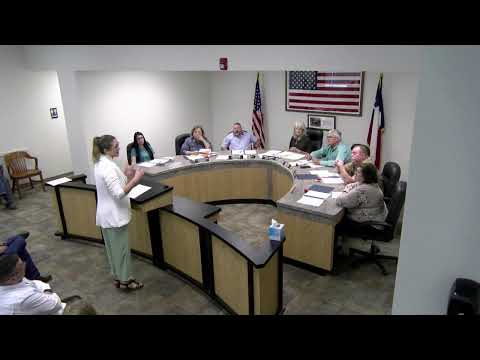
Polk County court debates legality and funding of constable‑provided school resource officers
Loading...
Summary
Commissioners heard an extended discussion about a proposed interlocal agreement with Goodrich ISD to fund a part‑time school resource officer. County legal counsel raised employment and liability questions; Constable Hughes urged retaining local services, and commissioners asked staff to research legal options and return the item.
Court members spent the largest portion of the March 24 meeting discussing a proposed interlocal cooperation agreement between Goodrich Independent School District and Polk County Precinct 1's constable office to provide a part‑time school resource officer (SRO).
The draft agreement presented to the court proposed Goodrich ISD paying $50,000 annually to fund roughly 1,520 hours for a part‑time SRO to serve district campuses. County staff said Texas Education Code §37 (as cited in the county's review packet) allows memoranda of understanding between districts and local law enforcement, but the county’s legal reviewer (Eric McGee of the Texas Association of Counties) raised concerns about the payment structure and employment status.
"The proposed draft agreement appears to be a combination of Chapter 791 and Chapter 37," a county attorney summary said, noting that a county employee status, payroll taxes, liability coverage, and the need for the sheriff's office to be the employing entity under some interpretations are all open legal questions.
Constable Hughes responded at length, defending his office’s years of providing SRO services in unincorporated areas and stressing community ties. "We have been providing security ... at 0 cost to taxpayers for over 3 and a half years," Hughes said, and he urged the court to find a legal path that preserves those locally provided services.
Commissioners and staff discussed alternatives: (1) the sheriff hiring the SRO as a county employee with school contributions; (2) the school hiring a W‑2 employee while a county agency carries commission/authority; (3) creating a school police department funded by grants; or (4) a contract model with careful W‑2 and commissioning arrangements. Several commissioners requested more time for legal research and recommended that the constables, the sheriff and county staff meet with affected ISDs to clarify practical and fiscal arrangements.
The court did not adopt the interlocal agreement on March 24; instead, members asked staff and legal counsel to compile options and to place the item on a future agenda with more detailed legal guidance and cost estimates. The Goodrich district's willingness to contribute $50,000 was noted but commissioners were told that the contribution alone "does not cover everything" because payroll taxes, benefits and county liabilities must be resolved.
Why it matters: The decision will shape how law enforcement is provided in unincorporated school districts, who bears fiscal responsibility, and whether the county must change personnel policies or create new employment structures to accommodate school security roles.
Next steps: Staff and legal counsel will research statutory constraints, payroll/liability structures and grant options; constables and the sheriff are to coordinate and present concrete alternatives at a future meeting.