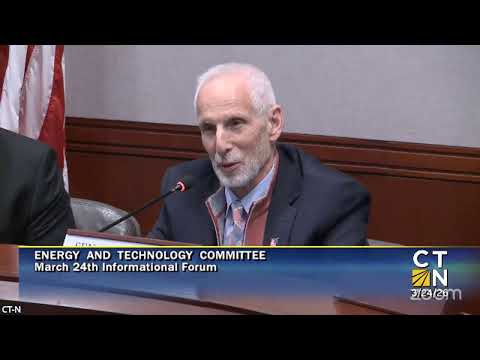
Connecticut Energy and Technology Committee holds public forum to review SB4 implementation and market pressures
Loading...
Summary
Lawmakers convened an informational forum to assess implementation of Public Act 25-173 (Senate Bill 4). DEEP, OCC, ISO New England and utilities described steps to manage supply volatility, transmission cost growth and the public benefits charge, and outlined next steps including an ISO asset‑condition reviewer filing to FERC.
The Energy and Technology Committee held an informational public forum to review implementation of Public Act 25‑173 (Senate Bill 4) and to assess how recent reforms are affecting reliability, affordability and environmental objectives.
Senator Needleman, co‑chair, opened the session by calling the meeting an “informational, educational” forum to look at where Connecticut has been and what the short‑ and long‑term future looks like for the state’s electric grid. Representative Jonathan Steinberg, co‑chair, said the committee needed an orderly evaluation of laws passed recently to see whether they are meeting their objectives for consumers and the grid.
Commissioner Dykes of the Department of Energy and Environmental Protection (DEEP) delivered the committee’s primary briefing, outlining how SB4 reshaped state authority on procurements and oversight. DEEP told the panel that long‑term state procurements—intended to hedge against wholesale market volatility—have added reliability and price mitigation tools, while other parts of the bill target transmission oversight and program performance funded through the public benefits charge.
DEEP highlighted several current themes: volatility in the ISO wholesale supply market since the pandemic, steady long‑term increases in transmission and delivery charges, and the role of public‑benefit programs in offsetting some wholesale pressures. The department pointed to recent procurements and to the Millstone nuclear contract as examples of hedging strategies the state used to reduce market exposure.
ISO New England officials and DEEP described a regional trajectory of higher transmission investment and the need for stronger regional oversight. Eric Johnson of ISO New England said the ISO will create an asset‑condition reviewer that states and advocates can use to evaluate transmission projects and appealed to the committee for continued regional cooperation.
Consumer Counsel Clark Coleman said OCC’s implementation work is focused on fairness and transparency for ratepayers and that the agency is engaging in procurements, securitization options for storm costs and efforts to make dynamic procurement and time‑varying rate options work without unduly shifting risk to vulnerable customers.
Utility representatives said their standard service procurement strategies have left Connecticut partly insulated from short‑term market swings, and that PURA’s procurement manager has recommended options for a modest dynamic tranche of spot purchases—an approach that can shave a small amount from long‑run supply costs while increasing exposure to market volatility for the portion that is unhedged.
The committee did not take votes. Co‑chairs said they will continue monitoring implementation and coordination among DEEP, OCC, PURA, ISO and utilities as the state steps through technical rulemaking and forthcoming filings.
The committee adjourned after further discussion of next steps involving FERC filings, technical studies and public outreach.