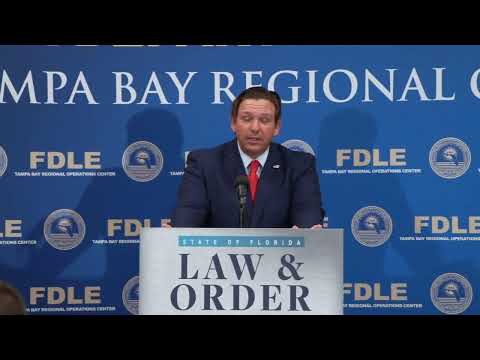
Governor DeSantis signs bills to stiffen penalties for child sexual offenses and AI-enabled abuse material
Loading...
Summary
At a bill-signing at the Tampa Bay FDLE center, Governor DeSantis signed House Bill 445 and House Bill 1159, measures that require custody after conviction for certain offenses and expand penalties for child sexual-abuse material, including AI-generated content. Law-enforcement officials praised the measures and cited recent arrest statistics.
TAMPA — Governor DeSantis signed two bills at the Tampa Bay Regional Operational Center that his office said will increase penalties and require custodial remand for certain child sexual offenses and expand criminal liability for child sexual-abuse material, including newly emergent AI-generated material.
The measures, described by the governor as "Missy's laws" and identified in remarks as House Bill 445 and House Bill 1159, were presented at the event as part of a long-running law-and-order agenda to protect children and strengthen prosecutors' tools. "What this bill does is it makes sure that these types of offenses mean that a judge must remand the convicted defendant to custody," Governor DeSantis said, arguing that mandatory remand would prevent repeat harm.
Supporters at the signing framed the laws as a necessary response to evolving threats and rising enforcement caseloads. The attorney general said law enforcement has increased enforcement activity, telling the audience there have been "over 1,400 child predator arrests" since he took office. Pinellas County Sheriff Bob Walteri cited local figures, saying, "In the last year alone, in Pinellas County, we have arrested 188 different people on child [sexual-abuse material] charges," and described a local prosecution his office says illustrates the scope of the problem.
House Bill 445: supporters and purpose
Supporters described House Bill 445 as requiring that defendants convicted of specified serious sexual offenses be remanded to custody while awaiting sentencing, rather than being released on bail. The governor cited a case involving a child identified as "Missy" and criticized a circuit judge's decision to allow the defendant to remain on bail pending sentencing; "If we had this bill in place then, Missy would be alive today," he said. The governor also urged the House of Representatives to consider impeachment proceedings against the judge mentioned in his remarks.
House Bill 1159: penalties and emerging threats
The governor described House Bill 1159 as increasing penalties for possession, creation and distribution of child sexual-abuse material, establishing mandatory minimum terms for specified offenses, and creating a life felony for aggravated exploitation of a child under 12. He and lawmakers at the event also flagged new language criminalizing AI-generated child sexual-abuse material, calling it an emerging threat.
Who spoke and how they justified the bills
Attorney General (at the event) praised law-enforcement activity and urged continued litigation where appropriate. "We have been part of a massive record over 1,400 child predator arrests," he said, characterizing the bills as giving prosecutors needed tools. The FDLE official hosting the event thanked partners and emphasized interagency cooperation: "It takes all of us," the official said, urging community reporting and collaboration.
Sheriff Walteri and Representative Bernie Shaw, sponsors and local officials in attendance, both voiced strong support. Shaw described the bills as "a continuation of the great partnership between law enforcement, the legislature, and the governor," and said he had sponsored measures to increase penalties.
Procedural notes and next steps
The governor said the family of the victim would be invited to witness the signing. No formal vote tallies or legislative amendments were recorded in the event transcript; lawmakers at the signing repeatedly described the bills as already passed by the legislature and ready for the governor's signature. The governor said the bills were ready to be signed and that the administration would continue to pursue related measures.
Context and caveats
Speakers repeatedly characterized the bills as responses to a rise in cases involving child sexual-abuse material and emerging AI threats. The statistics and case details cited at the event were attributed to law-enforcement speakers; the article does not independently verify those figures. Several speakers recommended further accountability measures for judges who they said violated their oaths, a claim the article reports as the speakers stated it during remarks.
The event included a brief question-and-answer period in which reporters asked about other topics including the renaming of Palm Beach Airport, special-election upsets, gas prices and childcare expansion; the governor responded but these items were separate from the bills being signed. The governor closed by urging continued legislative work on the budget, redistricting and property-tax issues.