Get AI Briefings, Transcripts & Alerts on Local & National Government Meetings — Forever.
GRTC tells Powhatan board Link microtransit pilot shows modest ridership gains, seeks funding and a second vehicle
Loading...
Summary
GRTC briefed the Powhatan Board on the countywide Link microtransit pilot, reporting seasonal ridership fluctuations, a higher booking window to reflect long county trips, an annual pilot cost near $250,000, and a pending DRPT funding application; residents urged adding a second vehicle to improve responsiveness.
GRTC representatives told the Powhatan County Board on March 23 that the countywide Link microtransit pilot has produced steady but modest ridership and that additional funding or an extra vehicle may be needed to make the service sustainable.
"Link is very much like an Uber or Lyft, but it is a public version of it," the presenter said, describing the app, web and phone booking options. The presenter said the pilot was launched in 2023 after a Richmond-region microtransit study and that the model in Powhatan has evolved into a countywide "pocket-zone" hybrid: vehicles operate on demand when in-zone and allow prebooking across long travel distances.
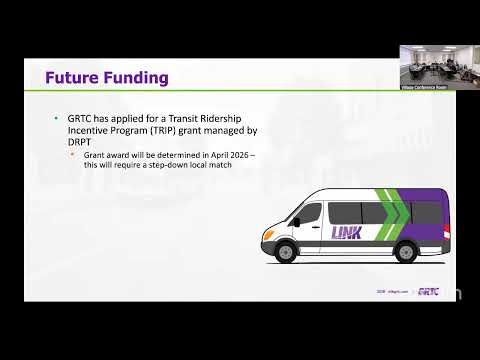
The presenter said the pilot's annual cost is about $250,000 and that DRPT and ARPA funds have helped underwrite the service so far. To improve reliability for long cross-county trips, the booking window was extended to about 90 minutes from earlier, shorter windows. "We have a little bit over a year left in the three-year pilot," the presenter added, noting the team has applied for DRPT incentives that phase down state support (80%, 60%, then smaller local matches over time).
Board members and residents pressed for comparative metrics and options to raise usage. One supervisor asked whether the county could be benchmarked against similar rural jurisdictions; the presenter said consultants have rural comparators and offered to provide the data.
Several participants urged adding a second vehicle so short intra-county hops would not be blocked when a single vehicle is tied up at a far end of the county. "When one vehicle is doing the far western end and another is on the far eastern end, you'd see the service levels increase," a resident said. The presenter said grant decisions expected in April could make additional vehicles possible.
Operations changes discussed included a forthcoming no-show policy (warnings then escalating short-term bans) intended to improve reliability and data cleanliness. The presenter also described outreach efforts at festivals and hiring a new outreach coordinator to grow visibility and repeat ridership.
The board did not take formal action at the March 23 meeting; staff said they would bring additional metrics, funding scenarios, and proposed operational changes back to the board for consideration if the DRPT application is successful.