Weston public works director outlines road network, staffing and funding pressures
Loading...
Summary
The Village of Weston finance committee received a detailed public works briefing on the extent of the village’s road, utility and maintenance responsibilities, staffing constraints and how transportation-aid formula caps reduced a preliminary $1.4 million payment to about $970,000 in 2026.
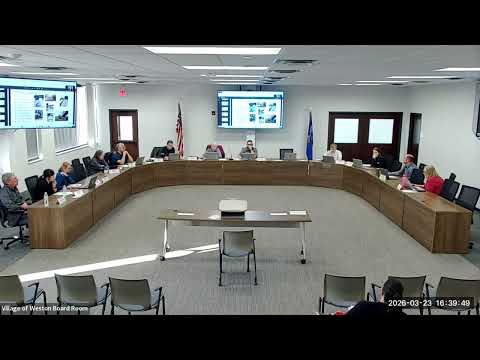
The Village of Weston Finance and Human Resource Committee heard a presentation from the public works director on the department’s 2026 operating priorities, projected costs and infrastructure inventory. The director told the committee the village maintains nearly 119.5 centerline miles of roads, roughly 50 pieces of equipment, about 114 miles of water main, 103 miles of sanitary sewer and roughly 70 miles of storm sewer.
The director said the public works operating budget for 2026 is about $2.2 million. He told the committee that the water, sewer and storm systems are enterprise funds funded by user rates, while street maintenance, winter and summer operations and street lighting are covered by the general fund. "It's our assets, it's our personnel, it's our management," he said, describing the scope of services the department provides.
Why it matters: the village is balancing wear-and-tear costs, staffing limits and irregular state aid. The director said contracted work planned for 2026 will treat about 7.2 miles of roadway (a little over 6 percent of the network) and that routine crack sealing targets roughly 20 percent of streets annually to slow pavement deterioration.
The director explained how state transportation aids are calculated and how a statutory cap affected Weston’s payment. He said the formula would have produced roughly $1.4 million but a cap tied to a percentage of the prior year produced a negative adjustment of about $438,000, leaving a final payment near the $970,000 figure presented in the packet. "If you stop spending money on streets, the state stops giving you money on streets," he said, warning that reduced project spending can lower future aid.
The committee also reviewed winter maintenance and storm response costs. The director said winter maintenance spending this year is a bit over $400,000, mostly wages and benefits, and estimated a recent multi-hour storm cost about $50,000 for fuel, equipment and overtime. He described the county and state disaster-relief process: Marathon County submits an initial estimate to the state, and if the county qualifies, individual municipalities later submit their specific costs.
Committee members questioned staffing levels and service capacity. The director said public works typically fields 10 frontline employees (9 at the time, with a new hire expected to return the crew to 10), plus park and utility staff that assist during storms. He highlighted in-house capabilities — crack sealing, curb and sidewalk work — that the village performs to save contracted costs.
The director listed recent large grants and reconstruction projects and estimated that the village has received more than $10 million in grants during his tenure for street projects such as Schofield Avenue and Ross Avenue. He also described salt procurement and storage: the village’s shed holds about 2,000 tons, roughly 1,000 tons were on hand, and the village ordered 1,500 tons; state contract terms preclude reselling salt for profit.
The committee was given a budget-status report and told the next meeting is tentatively scheduled for April 21, after newly elected trustees are sworn in. The director said more detailed budget pages are available in the packet for members who want to follow up.
The committee did not take a formal vote on any capital project at this meeting; the presentation was informational and intended to frame upcoming budget choices.