Get Full Government Meeting Transcripts, Videos, & Alerts Forever!
Get email alerts on the Budget topic
No spam. Unsubscribe anytime.
Lake Bluff finance committee recommends draft FY27–28 budget after CIP, water and stormwater briefings
Summary
The Village of Lake Bluff Finance Committee voted to recommend the draft FY27–28 budget to the full board after staff presented the capital improvement plan, water‑fund projections including a proposed 5% rate increase for FY27–28, and a plan to pursue bonding and federal funds for stormwater projects.
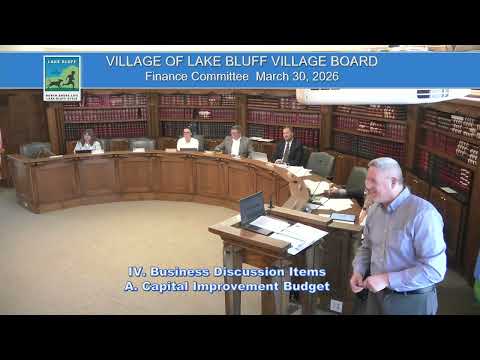
The Village of Lake Bluff Finance Committee voted to recommend the draft fiscal 2027–28 budget to the full board following staff presentations on the capital improvement plan (CIP), the water fund and the stormwater utility.
Chair Renner opened the discussion and Bettina, a village staff member, walked the committee through the 15‑year CIP summary showing cumulative spending across sanitary, stormwater, transportation and water funds and a multi‑year average of roughly $3.4 million. "This chart displays the totals of dollars that we've spent and what's projected and budgeted in the various categories of improvements," Bettina said.
On the water fund, staff described mounting capital needs and presented a model that would implement a 5% rate increase in each of FY27 and FY28, followed by 3% annually thereafter. "The rate increases that we looked at were a 5% rate increase for both years in the fiscal year plan," Bettina said. Staff warned that without increases the fund balance would decline over time and noted a water rate study due this summer could change the recommended structure.
Staff also described the stormwater utility fund (revenue about $850,000 per year) and the village's intent to bond to advance the "middle leg" of a deep trunk project. Staff reported the village has made an initial federal funding application and had a first cut at $10 million; staff said they have engaged Congressman Schneider's office and continue to pursue additional sources including potential IDOT participation. "We're not counting chickens, but at least we're in the mix," a staff member said of the federal application.
Committee members pressed staff on timing, community engagement and how rate changes would be communicated. Several members urged outreach well before any proposed rate change takes effect; staff pointed to past direct mailings and workshops as typical approaches.
After the discussion, a committee member moved to recommend the draft budget to the full board; the committee voiced aye and, with no opposition, the motion passed.
What happens next: staff will present the draft recommended budget to the full board and continue the water‑rate study and federal funding efforts for the stormwater project. The committee emphasized that community engagement about rate trade‑offs should begin before any formal rate proposal is presented to voters or ratepayers.