Planning board accepts community impact study for Woodward–Maple tower amid a heated parking debate
Loading...
Summary
The Birmingham Planning Board accepted the community impact study for a proposed mixed‑use project at Woodward and Maple but delayed the preliminary site‑plan decision after weeks of consultant disagreements over how many parking spaces the development must provide and whether publicly available spaces may count toward bonus height requirements.
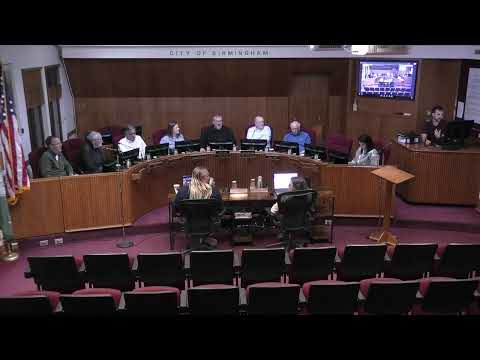
The Birmingham Planning Board on March 25 accepted the community impact study (CIS) for a proposed mixed‑use development at 34952 Woodward Avenue and 690 East Maple, but the board postponed preliminary site‑plan action to April 22 to give consultants and the city attorney time to reconcile competing parking analyses.
The developer, BezTek, presented a plan that includes roughly 224–228 residential units, about 15,000 square feet of retail and a 5,000‑square‑foot restaurant, and a parking garage the team says will yield 422 physical spaces (397 countable under ordinance dimensions). Planning staff and the city’s traffic reviewers told the board the ordinance would require roughly 351 spaces for the building’s private uses plus 198 public‑parking spaces tied to bonus‑height calculations — a 549‑space total under the code.
“The building is a little over that at almost 540,000 square feet,” said planning staff as part of the CIS presentation. Staff and the applicant agreed the project’s extra floors would require a board of zoning appeals review for a technical definition of an extra floor.
BezTek CEO Sam Besnos and the design team emphasized the project’s design and long‑term ownership plans. “I believe this site is the gateway into the city of Birmingham,” Besnos said, describing the development as a catalyst for the Triangle District.
The most contentious part of the meeting centered on parking math and the meaning of “parking available to the public” in the Triangle District overlay. City reviewers (identified in the record as Felice and Van den Breek) recommended a ULI‑based shared‑parking supply that they summarized as 288 spaces to serve residents and employees plus 90 spaces for customers/visitors. The city reviewers cautioned that the development will likely rely on some of the public spaces to meet peak demand.
Stonefield Engineering, the applicant’s traffic consultant, presented an updated shared‑parking analysis using ULI data and argued a lower development parking demand (266 for the development portion) and a holistic supply that would work with shared parking and internal capture. Nick Kennedy of Stonefield said the site “provides 422 physical parking spaces” and presented the methodology used to project time‑of‑day peaks.
Board members said they supported the shared‑parking principle but worried the ordinance’s bonus‑height provision could be read to require public parking that is genuinely available to the broader public rather than parking that the developer’s own users would effectively occupy — a difference that could amount to a substantial subsidy for private development. “If the city accepts that public good in a 198 parking spaces and then turns around and says you can use 50, 100, 150 of it to satisfy your required parking, the city is simply subsidizing your project,” the chair said.
Because the consultant analyses generated materially different numeric results, several members asked staff to obtain a formal opinion from the city attorney and to have the two traffic teams reconcile assumptions before the board makes any waiver or site‑plan decision. Commissioners also asked that the city’s parking usage data (for municipal decks and meters) be made available for consultants to test assumptions about daytime and evening peaks.
The board’s motion to accept the CIS required the applicant to resolve all transportation‑study issues raised by the city consultants, satisfy the CIS recommendations and comply with department requests; the motion passed by unanimous roll call.
The board then took up the preliminary site plan and design review portion of the application. After hearing additional design comments from the applicant team, the board voted unanimously to postpone consideration until a special meeting on 2026‑04‑22 so the consultants and city attorney could reconcile methodology and legal interpretation. Staff said the postponement would allow the team to refine parking management plans and to return with clarified, agreed‑upon inputs.
What’s next: the applicant has been asked to supply any additional shared‑parking assumptions and to coordinate a meeting between Stonefield and the city’s traffic consultants; the board requested a city‑attorney opinion on whether the bonus‑height public‑parking requirement may be counted against the project’s private parking needs when those spaces are available to the public at overlapping times.